
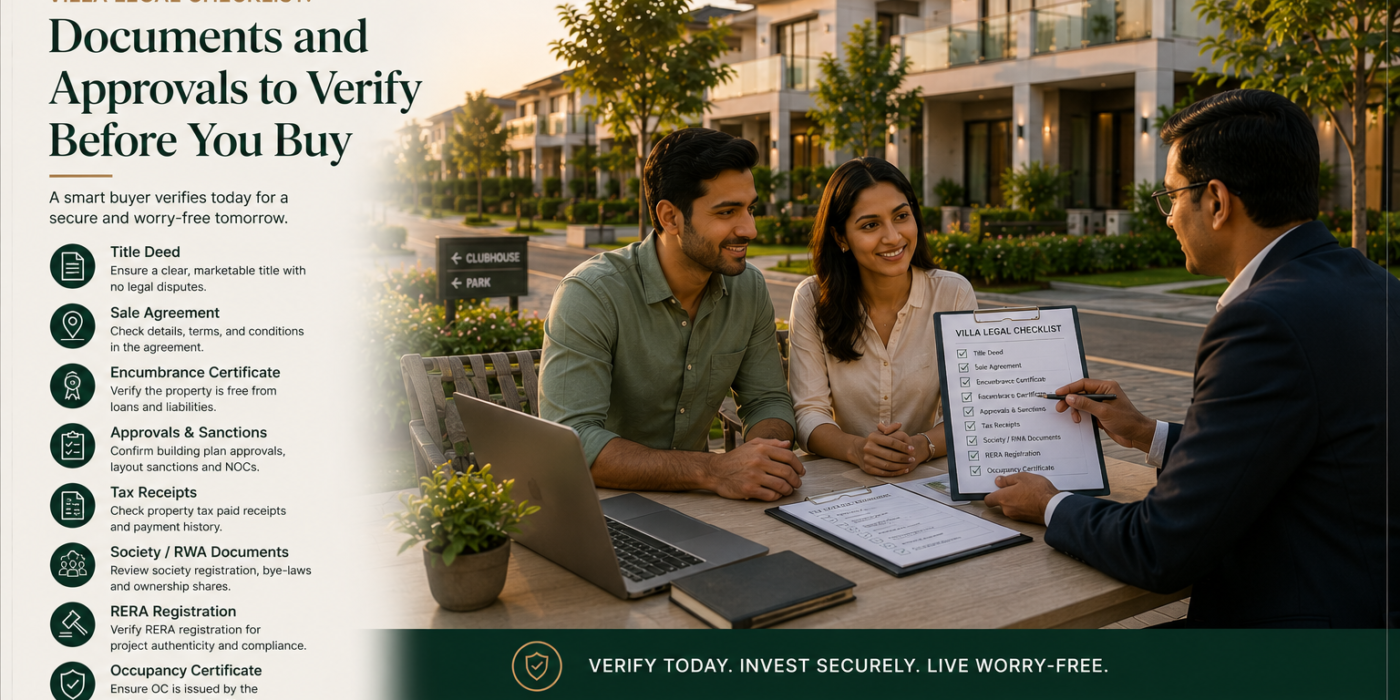
Buying a villa is one of the biggest financial decisions most families make, and getting the legal groundwork right matters just as much as choosing the right location or floor plan. A proper legal checklist covers land title records, building approvals, and statutory clearances that together confirm a villa is safe to purchase, legally sound, and free of future disputes. For anyone planning to buy villa in Bangalore, this isn’t a box-ticking formality. It’s the difference between owning a home with a clean, transferable title and inheriting someone else’s unresolved paperwork years down the line.
The tricky part is that a villa carries more legal layers than a flat or an apartment. You’re not just buying a constructed unit, you’re also buying a share in the land beneath it, which means the developer’s original title, the layout approval for the entire community, and the individual building sanction all need to check out. Many buyers assume that if a project looks polished and well-marketed, the paperwork must be equally solid, but that assumption has cost people real money in Bangalore’s fast-growing suburbs.
In this blog, we’ll walk through the essential documents and approvals you should verify before signing anything.
Why a Villa Purchase Needs More Legal Scrutiny Than a Flat
When you buy an apartment, the builder typically owns the land outright and your legal exposure is limited to the unit itself. A villa, especially one inside a gated community, works differently. The developer first acquires a large parcel of land, gets it approved as a residential layout, and then creates individual villa plots within that layout. If any step in that chain is incomplete, the risk doesn’t stay with the developer alone, it passes on to every homeowner in the project.
This is why due diligence for villa properties in Bangalore has to happen at two levels: the project level, where you check the mother land’s title and the layout’s approval status, and the individual unit level, where you verify the specific villa’s sale deed, encumbrance history, and building sanction. Skipping either one leaves a gap that can surface much later, often right when you’re trying to sell or take a home loan against the property.
The Land Title Documents You Must Verify First
Every legal checklist for villa buyers should start with the Mother Deed, since it establishes the earliest traceable ownership of the land and the full chain of transfers since then. Ask for at least 20 to 30 years of title history where possible, and confirm there are no breaks or unexplained gaps in that chain.
Alongside the Mother Deed, you’ll need the Sale Deed of the specific villa, an Encumbrance Certificate confirming the property carries no pending loans or legal claims, and, where the land was originally agricultural, the RTC and DC Conversion Order showing it was legally converted for residential use. A property lawyer can pull most of these directly from the Sub-Registrar’s office, and it’s worth having them do so rather than relying solely on copies the seller provides.
What Does RERA Registration Actually Confirm?
RERA registration confirms that a residential project has been formally declared to the Karnataka Real Estate Regulatory Authority, with details on land title, approved plans, and construction timelines made publicly available. You can check any project’s status directly on the RERA Karnataka portal using its registration number.
What RERA registration does not do is guarantee that the underlying land title is dispute-free. It’s a transparency mechanism, not a substitute for your own document verification. Treat it as one confirmation among several, not the final word.
Layout and Building Approvals to Check for Gated Villa Communities
Beyond the land title, gated villa communities need a valid layout approval, often referred to by its LP Number, issued by the BDA or the relevant local planning authority. Without this, the layout itself is technically unauthorised, regardless of how developed the community looks on the ground. Ask for this number directly and cross-check it rather than taking the developer’s word for it.
You’ll also want the BBMP or panchayat-sanctioned building plan for the individual villa, which confirms the structure was built according to approved specifications. A well-run developer will have these documents organised and ready to share, since a legitimate project has nothing to hide at this stage.
Khata, Property Tax, and Ownership Records
Khata records establish a property’s standing in municipal revenue records, and Bangalore has been shifting properties toward the digital e-Khata (e-Aasthi) system. A property still sitting on an older B-Khata often needs regularisation before it can be cleanly transferred, which can affect both registration and home loan eligibility, so it’s worth clarifying this upfront rather than discovering it mid-transaction. Recent property tax receipts are equally worth checking, since irregular payment history can sometimes point to unresolved Khata issues.
How to Actually Verify These Documents Before You Buy
Most of these checks can start online. RERA status, Khata records, and property tax history are all searchable through official Karnataka government portals, which gives you a quick first read before committing further. That said, title verification and encumbrance checks are best handled by a property lawyer who can trace ownership history properly and flag anything that needs a closer look.
If you’re working with an established developer, this process tends to move faster simply because the documentation already exists in an organised form. Geown Properties, for instance, structures its villa communities around clear, verifiable title and approval records from the outset, which is the kind of transparency this checklist is really asking every buyer to look for.
Conclusion
A thorough legal checklist protects you long after the purchase is complete, whether that’s during resale, refinancing, or simply passing the property on to your family without complications. Verifying the Mother Deed, RERA status, layout approval, and Khata records isn’t about distrusting a developer, it’s about making an informed decision on one of the largest purchases you’ll ever make.
If there’s one habit worth building before you buy villa in Bangalore, it’s asking to see the paperwork before you fall in love with the model home. A well-planned villa community will always welcome that scrutiny, and the ones that hesitate are usually telling you something worth listening to.