
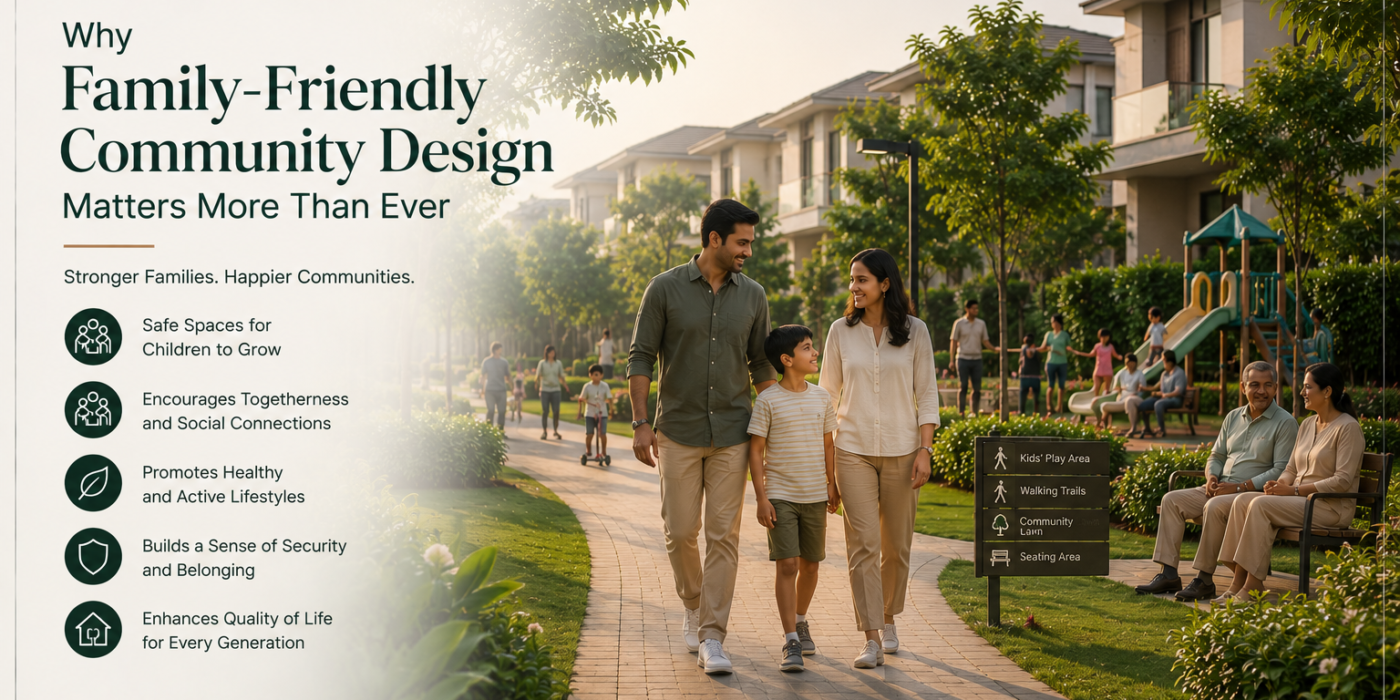
Raising a family today looks different than it did even a decade ago, and where you choose to live plays a bigger role in that shift than most people realise. Family-friendly villa communities have moved from being a nice-to-have to a genuine priority for parents, working professionals, and even NRI investors scouting long-term homes in Bangalore. The reason is simple: the physical layout of a neighbourhood shapes how safely children play, how easily families connect with neighbours, and how much daily stress a household carries.
This shift isn’t just about aesthetics or bigger floor plans. It’s about whether a five-year-old can cycle down a street without a parent hovering nearby, whether there’s a shaded park within walking distance, or whether the community actually encourages people to step outside and know each other. As cities grow denser and commutes get longer, these small design choices end up shaping a family’s quality of life far more than the size of the living room does.
In this blog, we’ll look at what family-friendly design really means, why demand for it is rising in Bangalore, and how the right community can shape both a child’s everyday life and a family’s long-term investment.
What Does Family-Friendly Community Design Actually Mean?
It’s tempting to assume “family-friendly” just means a playground and a clubhouse, but that’s a fairly shallow read of what actually matters to parents. Genuine community design for families factors in how people move through a space, how safe children feel exploring it, and how naturally neighbours interact with one another. It’s less about a checklist of amenities and more about the underlying logic of the layout itself.
Research on residential planning consistently points to a few non-negotiable elements:
- Traffic-calmed internal roads and pedestrian-first pathways
- Green, landscaped spaces that aren’t just decorative but usable
- Low-density layouts that allow for both privacy and casual interaction
- Play areas with soft surfacing and some form of natural, indirect supervision
- Proximity to schools, clinics, and daily conveniences
When these elements come together, they create something apartments in dense high-rises often struggle to replicate.
The Growing Demand for Family-Friendly Villa Communities in Bangalore
Bangalore’s growth corridors, Devanahalli, Sarjapur Road, Whitefield, and Hebbal among them, have seen a noticeable shift in buyer priorities over the past couple of years. Families who once defaulted to apartment living are now actively seeking villa communities that offer private outdoor space, lower density, and a sense of ground-level freedom for their children. Part of this is practical: elderly parents and pets manage far better with direct ground access than with lift-dependent high-rises.
There’s also a generational piece to this. Remote and hybrid work has made people rethink how much of their day is actually spent at home, and that’s pushed buyers toward neighbourhoods that support a fuller lifestyle, not just a place to sleep.
How Thoughtful Design Shapes a Child’s Everyday Life
Good design doesn’t just look pleasant in a brochure. It changes how children actually spend their afternoons.
Safe, Traffic-Free Play Areas
Internal roads designed with speed bumps, clear sightlines, and minimal vehicle movement give children room to be children without constant adult intervention.
Access to Green and Open Spaces
Landscaped gardens and open lawns aren’t just visual softness. They give kids room to run, explore textures, and spend time outdoors instead of being confined indoors.
Opportunities for Independent Play and Social Growth
Communities that allow children some degree of unsupervised, low-risk exploration help build confidence and social skills that overly controlled environments tend to suppress.
What Makes a Residential Community Truly Child-Friendly?
A community earns that label when safety, layout, and amenities work together rather than existing as separate checkboxes. That means gated access with visible security, walkable internal paths, age-appropriate play zones, and enough green cover that outdoor time feels inviting rather than optional. It also means proximity to schools and healthcare, so daily logistics don’t eat into family time.
Long-Term Value: Why Family-Friendly Design Is Also a Smart Investment
For homebuyers and investors alike, well-planned child-friendly residential communities tend to hold and appreciate value better than generic developments. Families prioritise these neighbourhoods for resale and rental demand too, which makes thoughtful design a financial consideration, not just a lifestyle one. Locations with strong connectivity and consistent demand from young families have historically shown steadier appreciation over time.
How Geown Properties Approaches Community Design for Families
At Geown Properties, this thinking shapes every project from the ground up. The focus stays on contemporary architecture paired with genuinely spacious layouts, well-connected locations, and security systems that let parents relax a little. Sustainable practices like efficient water management and thoughtful landscaping aren’t afterthoughts either, they’re built into the plan from day one, alongside amenities designed around how families actually spend their time together.
Conclusion
Choosing a home today means choosing the environment your children will grow up in, and that decision carries weight well beyond square footage. Family-friendly villa communities offer something that’s difficult to manufacture later: a setting where safety, nature, and everyday convenience are already built into the plan.
For families evaluating their next move, it’s worth looking past the surface-level amenities list and asking harder questions about walkability, safety, and how a community actually functions day to day. The right answer to those questions tends to matter far more, ten years down the line, than anything a floor plan alone can promise.