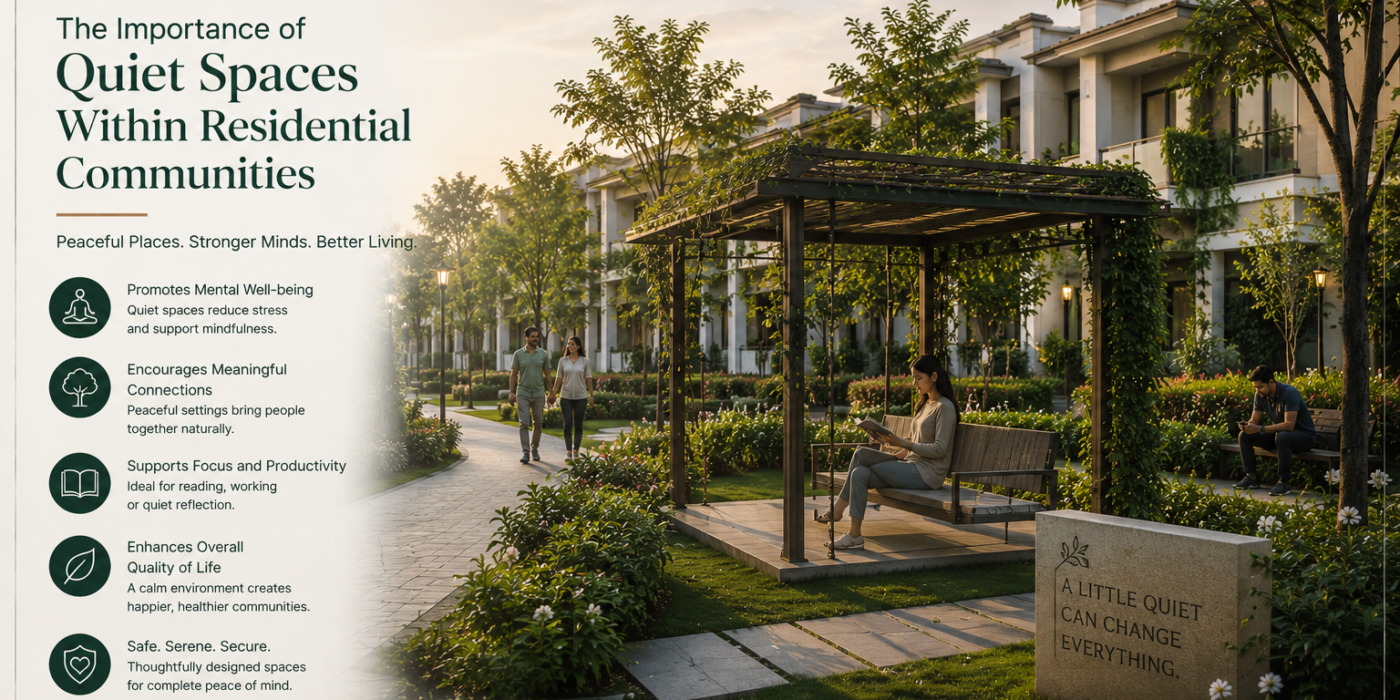
Premium villa community featuring a peaceful landscaped garden with shaded seating, reading corners, pergolas, and lush greenery, where Indian residents relax, read, and enjoy quiet moments, highlighting the importance of dedicated quiet spaces for mental well-being, relaxation, and a balanced residential lifestyle.
CategoriesBlog

The Importance of Quiet Spaces Within Residential Communities

Quiet Spaces in Residential Communities are quickly becoming one of the most sought-after features for homebuyers, and it’s not hard to see why. As cities grow louder and daily life gets busier, the ability to return home to genuine calm has shifted from a nice-to-have to a defining factor in where people choose to live.

For growing families, working professionals, and investors alike, noise affects far more than comfort. It shapes sleep quality, focus, mental wellbeing, and even how children grow up experiencing their surroundings. A home that offers real peace isn’t just pleasant, it’s practical. 

In this blog, we’ll look at why quiet spaces matter so much in residential planning, what actually makes a community peaceful, and how thoughtful design brings this to life.

Why Quiet Has Become a Priority for Today’s Homebuyers

Bangalore’s rapid growth has brought incredible opportunity, but also constant noise from traffic, construction, and dense development. Many buyers who once prioritized proximity above everything else are now rethinking what “location” really means. A well-connected home that still feels chaotic inside its own gates isn’t the win it once was.

This shift has been accelerated by remote and hybrid work becoming permanent fixtures for many professionals. When your living room doubles as your office, the noise levels around you directly affect your output. Families have noticed the difference too, especially those raising young children who need consistent routines and undisturbed rest.

The Real Impact of Noise on Everyday Life

The connection between noise and wellbeing isn’t just anecdotal. Research has consistently linked constant exposure to high noise levels with disrupted sleep, elevated stress, and long-term effects on cardiovascular health. Quiet Spaces in Residential Communities, on the other hand, have been shown to support better rest and a genuine sense of restoration.

For children, calm surroundings matter for concentration, play, and healthy development. For adults, they make the difference between coming home to recover from the day or coming home to more of the same noise they just left behind.

What Actually Makes a Quiet Spaces in Communities?

Quietness rarely happens by accident. It’s usually the result of deliberate planning decisions made long before a single villa is built.

Thoughtful Master Planning: Villa placement, road layouts, and distances from main traffic corridors are planned to naturally reduce sound intrusion into living spaces.

Landscaped Buffers and Green Zones: Trees, hedges, and landscaped strips do more than look good. They physically absorb and deflect sound, acting as a natural barrier between homes and outside noise.

Low-Density Layouts: Communities with more breathing room between homes tend to feel calmer simply because there’s more distance and greenery between neighbours.

Quality Construction and Acoustic Design: Solid building materials, proper insulation, and well-sealed windows and doors reduce how much outside noise actually makes it indoors.

The Role of Quiet Spaces in Communities in Everyday Calm

Community open spaces play a quieter but equally important role in shaping how peaceful a neighbourhood feels day to day. Parks, courtyards, and walking trails don’t just add greenery, they create natural gaps between activity zones and living areas.

Well-designed open spaces typically offer:

  • Buffer zones that absorb noise before it reaches homes
  • Walking paths and gardens for unwinding without leaving the community
  • Safe, low-traffic areas where children can play freely
  • Shared spots for residents to relax or connect without crowding

When these spaces are planned well, they end up doing double duty, giving residents room to breathe while quietly protecting the peace of the homes around them.

Does a Quiet Community Affect Property Value?

Yes, and the connection is stronger than many buyers realise. Homes in peaceful, well-planned communities tend to hold their value better over time simply because demand for liveability keeps rising. As more buyers actively search for calm, low-noise environments, communities that already offer this become harder to replicate and, in turn, more valuable.

Choosing a Villa Community Built Around Peaceful Living

Not every gated community delivers genuine peace, even if the brochure promises it. It helps to look closely at layout density, the amount of usable green space, distance from main roads, and how seriously acoustic detailing was treated during construction.

This is the thinking behind how Geown Properties approaches its villa projects, with layouts, landscaping, and construction quality planned around everyday liveability rather than just aesthetics. The goal is straightforward: villas that feel calm on a Tuesday evening, not just in a promotional photo.

Ultimately, peaceful villa living comes down to details most buyers don’t see until they’ve already moved in. Wide setbacks, generous greenery, sound-conscious construction, and low-density planning all work together quietly in the background.

Conclusion

Quiet Spaces in Residential Communities aren’t a luxury add-on anymore, they’re becoming a baseline expectation for anyone serious about long-term comfort and value. As more families and professionals prioritise wellbeing alongside location and price, developers who build genuine calm into their communities will be the ones defining what premium living actually means.

If there’s one thing worth remembering when evaluating a villa project, it’s this: a beautiful home surrounded by constant noise is still a compromise. True comfort comes from a community designed, from the ground up, to let residents actually enjoy the Quiet Spaces in Communities.


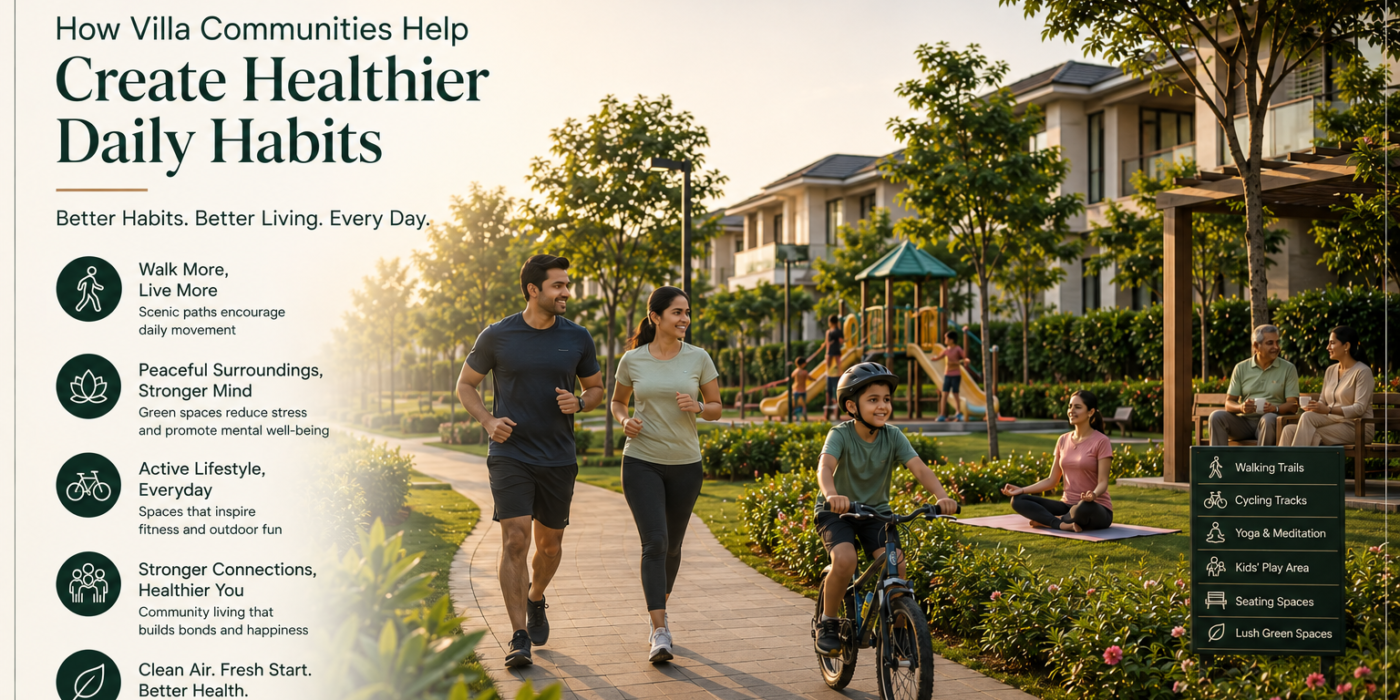
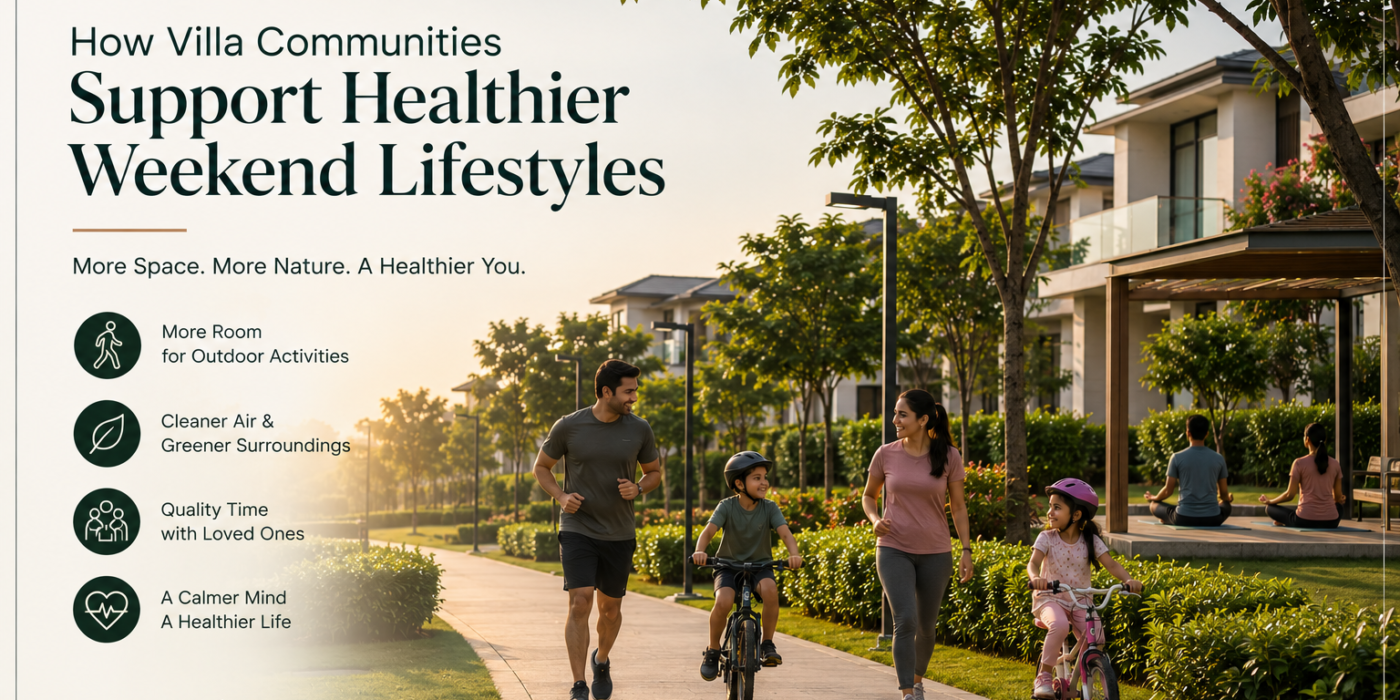
Premium villa community with landscaped walking trails, cycling paths, green open spaces, and Indian families jogging, cycling, practicing yoga, and spending time outdoors, showcasing how thoughtfully designed villa communities encourage healthier daily habits and active lifestyles.
CategoriesBlog

How Villa Communities Help Create Healthier Daily Habits

Villa Communities for Healthier Habits do more than look good on a brochure. The way a community is designed, its open spaces, walking paths, and low-density layout, quietly shapes how residents move, unwind, and interact every single day. It’s not about willpower or discipline. It’s about an environment that makes healthier choices the easy choices.

Most urban lifestyles today revolve around long commutes, screen-heavy workdays, and very little unstructured outdoor time. Add to that the isolation that comes with high-density apartment living, and it’s easy to see why so many families feel like they’re constantly trying to “fit in” a walk or a workout rather than having it happen naturally. This is exactly where thoughtfully planned communities change the equation. 

In this blog, we’ll look at how villa communities support movement, connection, and long-term wellness as part of everyday routine, not as an extra task on the to-do list.

Why Everyday Environment Shapes Health More Than Willpower

Habits are rarely built through motivation alone. They’re built through convenience. A person is far more likely to walk in the evening if there’s a shaded path right outside their door than if it requires driving somewhere. The same logic applies to socializing, relaxing outdoors, or even eating better, since access and ease drive behaviour more than intention does.

This is one reason wellness-focused community living has become such a strong theme in premium residential planning. Developers now recognize that a resident’s health outcomes are tied closely to the physical spaces around their home. Villas built within thoughtfully designed communities tend to reduce the friction between wanting to be active and actually being active, simply because the option is always right there.

Open Spaces and Walking Tracks That Make Movement Effortless

Landscaped walking tracks, tree-lined paths, and open gardens turn movement into something that happens on the way to somewhere else rather than a separate task. A morning walk before work, an evening stroll after dinner, kids cycling along a safe internal road, these become part of the rhythm of the day instead of an appointment.

Low traffic and controlled entry points also mean residents feel safe stepping out at any hour, which matters more than people often realize. Many families in denser neighbourhoods simply skip outdoor activity because the surroundings don’t feel walkable or secure.

What Makes a Villa Community Genuinely Wellness-Focused?

A wellness-focused villa community generally combines a few specific things: generous green cover, low-density planning that avoids overcrowding, dedicated fitness and recreation zones, walkable internal roads, and design choices that prioritize natural light and airflow. It’s the combination of these elements, not any single amenity, that creates a setting where healthier routines happen almost automatically.

How Community Amenities Support an Active Lifestyle Every Day

An active lifestyle in Villa Communities for Healthier Habits is largely a product of what’s available within a short walk from home.

Fitness and Recreation Spaces

Gyms, sports courts, and yoga lawns remove the usual excuse of “no time to travel to a fitness centre.” When a workout space is a two-minute walk away, people show up more consistently.

Family and Social Spaces

Clubhouses and shared gathering areas give families a reason to step outside together. Evening get-togethers, weekend games, or simply chatting with neighbours while children play nearby all add up over time.

Green and Outdoor Spaces

Parks, gardens, and seating areas offer a slower kind of wellness, encouraging residents to unwind outdoors rather than spend every evening indoors in front of a screen.

The Mental and Social Side of Healthy Habits

Health isn’t only physical. Villa Communities for Healthier Habits, by design, tend to reduce noise and crowding, which has a real effect on stress levels. Add regular interaction with neighbours, and residents often build a genuine support system rather than living in isolation behind closed doors. That sense of belonging plays a bigger role in long-term wellbeing than most people expect.

Do Villa Communities Really Make a Long-Term Difference to Health?

Yes, though the change tends to be gradual rather than immediate. Residents don’t usually experience dramatic shifts overnight. What happens instead is a slow, steady accumulation of small choices, an extra walk here, a shared evening there, that compound into meaningfully better routines over months and years.

Choosing a Villa Community Built Around Everyday Wellness

When evaluating a villa project, it helps to look beyond the floor plan and consider how the overall community is planned. Connectivity to workplaces and schools, the quality of construction, sustainability features, and the genuine presence of usable open spaces all matter more than they might seem to at first glance. 

Geown Properties approaches villa development with exactly this lens, designing communities around contemporary architecture, spacious layouts, and everyday comfort, so residents get a lifestyle that supports both convenience and long-term wellbeing, not just a well-finished home.

Conclusion

Villa Communities for Healthier Habits work because they remove the friction between intention and action. Walking, connecting with neighbours, and spending time outdoors stop being things people have to plan for and simply become part of how each day unfolds. For homebuyers, growing families, working professionals, and NRI investors alike, this everyday design advantage is often what separates a house from a genuinely well-lived-in home.

Choosing where to live is ultimately choosing the routines you’ll fall into without even trying. A well-planned villa community doesn’t just offer a better address, it quietly nudges everyday life toward being a little healthier, a little more connected, and a lot more enjoyable.

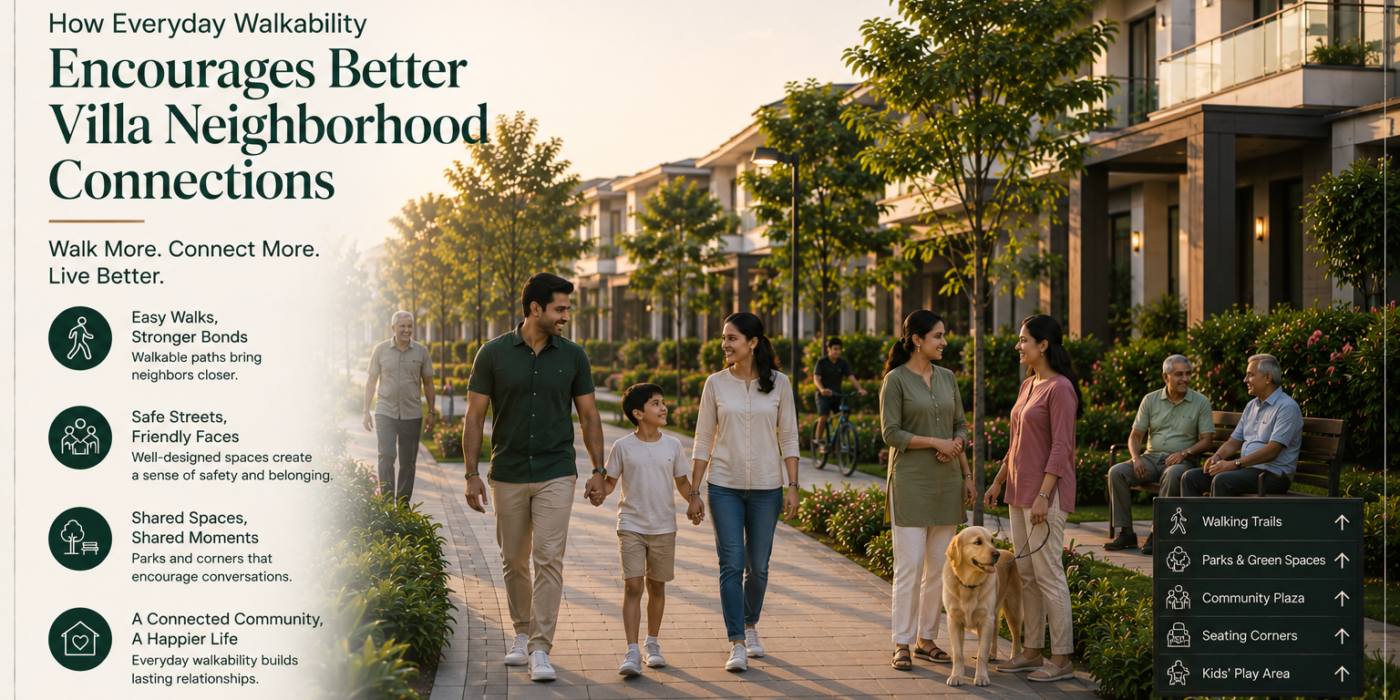
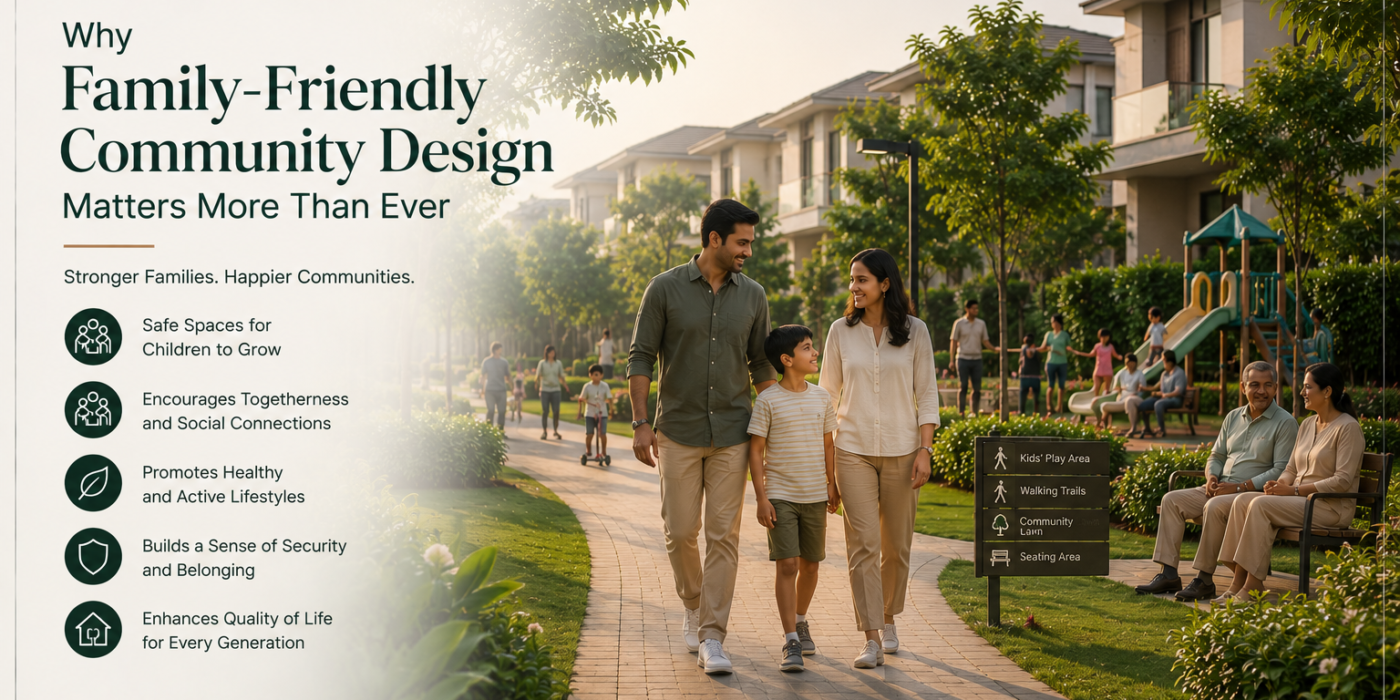
Premium villa community with landscaped walkways, children's play area, green open spaces, and Indian families enjoying quality time together, illustrating how family-friendly community design creates safer, healthier, and more connected neighborhoods for every generation.
CategoriesBlog

Why Family-Friendly Community Design Matters More Than Ever

Raising a family today looks different than it did even a decade ago, and where you choose to live plays a bigger role in that shift than most people realise. Family-friendly villa communities have moved from being a nice-to-have to a genuine priority for parents, working professionals, and even NRI investors scouting long-term homes in Bangalore. The reason is simple: the physical layout of a neighbourhood shapes how safely children play, how easily families connect with neighbours, and how much daily stress a household carries.

This shift isn’t just about aesthetics or bigger floor plans. It’s about whether a five-year-old can cycle down a street without a parent hovering nearby, whether there’s a shaded park within walking distance, or whether the community actually encourages people to step outside and know each other. As cities grow denser and commutes get longer, these small design choices end up shaping a family’s quality of life far more than the size of the living room does. 

In this blog, we’ll look at what family-friendly design really means, why demand for it is rising in Bangalore, and how the right community can shape both a child’s everyday life and a family’s long-term investment.

What Does Family-Friendly Community Design Actually Mean?

It’s tempting to assume “family-friendly” just means a playground and a clubhouse, but that’s a fairly shallow read of what actually matters to parents. Genuine community design for families factors in how people move through a space, how safe children feel exploring it, and how naturally neighbours interact with one another. It’s less about a checklist of amenities and more about the underlying logic of the layout itself.

Research on residential planning consistently points to a few non-negotiable elements:

  • Traffic-calmed internal roads and pedestrian-first pathways
  • Green, landscaped spaces that aren’t just decorative but usable
  • Low-density layouts that allow for both privacy and casual interaction
  • Play areas with soft surfacing and some form of natural, indirect supervision
  • Proximity to schools, clinics, and daily conveniences

When these elements come together, they create something apartments in dense high-rises often struggle to replicate.

The Growing Demand for Family-Friendly Villa Communities in Bangalore

Bangalore’s growth corridors, Devanahalli, Sarjapur Road, Whitefield, and Hebbal among them, have seen a noticeable shift in buyer priorities over the past couple of years. Families who once defaulted to apartment living are now actively seeking villa communities that offer private outdoor space, lower density, and a sense of ground-level freedom for their children. Part of this is practical: elderly parents and pets manage far better with direct ground access than with lift-dependent high-rises.

There’s also a generational piece to this. Remote and hybrid work has made people rethink how much of their day is actually spent at home, and that’s pushed buyers toward neighbourhoods that support a fuller lifestyle, not just a place to sleep.

How Thoughtful Design Shapes a Child’s Everyday Life

Good design doesn’t just look pleasant in a brochure. It changes how children actually spend their afternoons.

Safe, Traffic-Free Play Areas

Internal roads designed with speed bumps, clear sightlines, and minimal vehicle movement give children room to be children without constant adult intervention.

Access to Green and Open Spaces

Landscaped gardens and open lawns aren’t just visual softness. They give kids room to run, explore textures, and spend time outdoors instead of being confined indoors.

Opportunities for Independent Play and Social Growth

Communities that allow children some degree of unsupervised, low-risk exploration help build confidence and social skills that overly controlled environments tend to suppress.

What Makes a Residential Community Truly Child-Friendly?

A community earns that label when safety, layout, and amenities work together rather than existing as separate checkboxes. That means gated access with visible security, walkable internal paths, age-appropriate play zones, and enough green cover that outdoor time feels inviting rather than optional. It also means proximity to schools and healthcare, so daily logistics don’t eat into family time.

Long-Term Value: Why Family-Friendly Design Is Also a Smart Investment

For homebuyers and investors alike, well-planned child-friendly residential communities tend to hold and appreciate value better than generic developments. Families prioritise these neighbourhoods for resale and rental demand too, which makes thoughtful design a financial consideration, not just a lifestyle one. Locations with strong connectivity and consistent demand from young families have historically shown steadier appreciation over time.

How Geown Properties Approaches Community Design for Families

At Geown Properties, this thinking shapes every project from the ground up. The focus stays on contemporary architecture paired with genuinely spacious layouts, well-connected locations, and security systems that let parents relax a little. Sustainable practices like efficient water management and thoughtful landscaping aren’t afterthoughts either, they’re built into the plan from day one, alongside amenities designed around how families actually spend their time together.

Conclusion

Choosing a home today means choosing the environment your children will grow up in, and that decision carries weight well beyond square footage. Family-friendly villa communities offer something that’s difficult to manufacture later: a setting where safety, nature, and everyday convenience are already built into the plan.

For families evaluating their next move, it’s worth looking past the surface-level amenities list and asking harder questions about walkability, safety, and how a community actually functions day to day. The right answer to those questions tends to matter far more, ten years down the line, than anything a floor plan alone can promise.

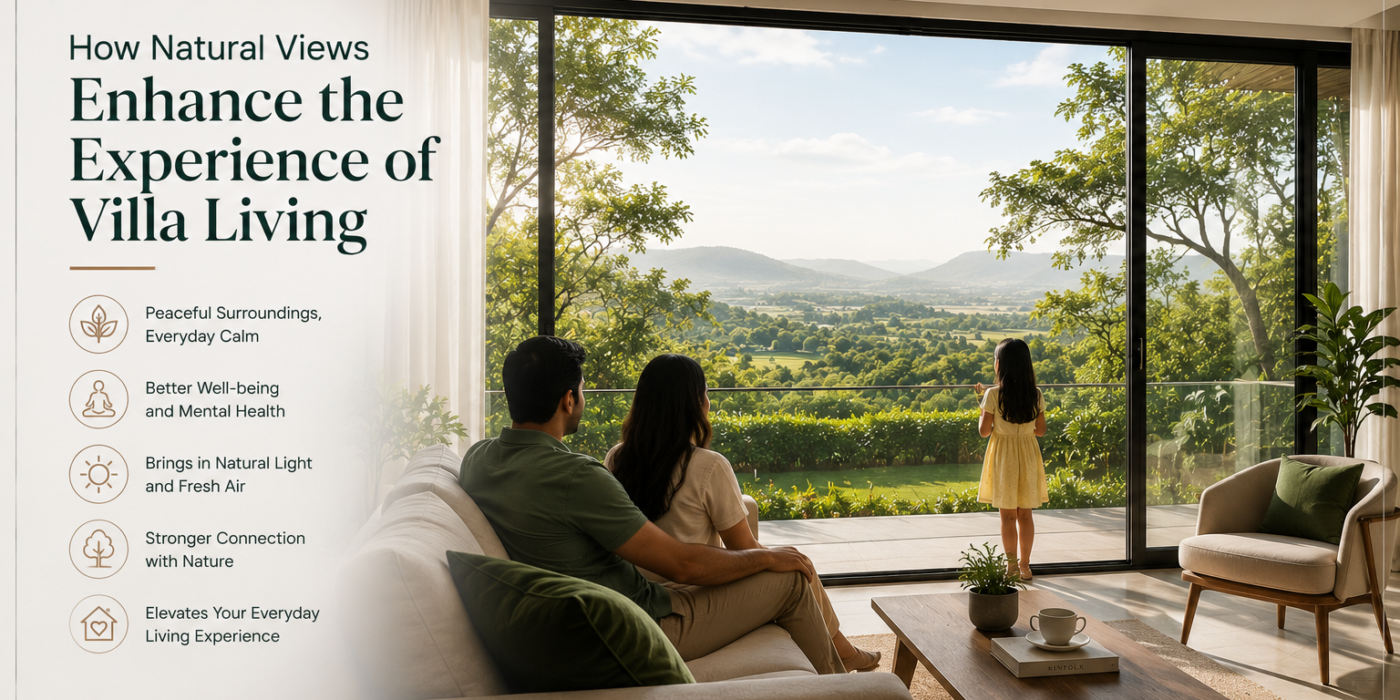
Modern luxury villa living room with floor-to-ceiling glass windows overlooking lush greenery, hills, and scenic landscapes, as an Indian family enjoys the peaceful natural views, highlighting how nature enhances comfort, well-being, and the villa living experience.
CategoriesBlog

How Natural Views Enhance the Experience of Villa Living

Waking up to a view of trees swaying outside your window instead of a neighbour’s compound wall changes something in how a day begins. It’s a small thing on paper, but for anyone who has lived both experiences, it’s rarely small in practice. Villas with natural views do more than look good in a brochure. They shape mood, routine, and even how a family spends its evenings together, which is exactly why this feature has moved from “nice to have” to a genuine deciding factor for homebuyers today.

The shift makes sense when you think about how most people actually live now. Long work hours, screen fatigue, and increasingly congested cities have made green, open surroundings feel less like a luxury and more like a basic need. Buyers aren’t just asking whether a home has enough rooms anymore. They’re asking whether it will actually help them feel calmer at the end of the day. 

In this blog, we’ll look at why natural views matter, what sets scenic villa communities apart, and how this kind of setting affects both daily living and long-term value.

Why Natural Views Matter More Than You’d Think

There’s a reason architects and urban planners keep circling back to greenery and open views when they talk about wellbeing. It isn’t just aesthetic preference. Research into biophilic design, the idea that humans respond positively to natural elements in their surroundings, has repeatedly linked exposure to greenery and daylight with lower stress and better focus. When windows frame trees or landscaped gardens instead of concrete, the effect on how a space feels is immediate.

For families in particular, this translates into something very concrete: fewer indoor, screen-heavy evenings and more time spent outdoors without having to travel anywhere. A few of the everyday effects that natural views tend to have on residents include:

  • Reduced stress and a calmer transition between work and home life
  • Better sleep patterns linked to natural light exposure through the day
  • More opportunities for outdoor family time without leaving the property
  • A general sense of space and openness that indoor design alone can’t fully replicate

None of this is about escaping the city entirely. It’s about designing homes so that nature isn’t something you drive to on weekends, but something you live alongside.

What Makes Scenic Villa Communities Different

Not every villa project delivers on this promise, even when the marketing suggests otherwise. Scenic villa communities are planned differently from the start. Instead of maximising the number of units on a plot, the layout is built around preserving tree cover, open sightlines, and low-density spacing between homes. That’s a deliberate trade-off, and it’s usually the one that separates a genuinely scenic community from one that simply has a garden near the entrance.

Geown Properties approaches this the same way, treating landscape as part of the architectural plan rather than an afterthought squeezed in once construction is done. Thoughtful road placement, retained greenery, and homes oriented to face open views rather than each other all come from decisions made early, not late.

Do Villas With Natural Views Cost More to Maintain?

It’s a fair question, and the honest answer is: usually not significantly. Most of the maintenance in these communities is handled at the community level through shared landscaping and upkeep, not by individual homeowners tending large plots themselves. What buyers do pay for upfront is the scarcity of land that offers unobstructed views in the first place, which is a one-time cost reflected in the property’s price rather than an ongoing burden.

Everyday Lifestyle Benefits Across Different Buyers

The appeal of villas with natural views isn’t limited to one type of buyer. It shows up differently depending on who’s living there.

For Growing Families

Children get room to play outdoors safely, within sight of home, and parents get a bit of peace of mind that comes with low-traffic, green surroundings.

For Working Professionals

A view that changes with the seasons, rather than a wall of identical windows, makes it easier to switch off after a long day, especially for those working from home.

For NRI Investors and Second-Home Buyers

Scenic, well-connected villa communities tend to hold their appeal across visits, making them easier to rent, maintain remotely, or simply enjoy on return trips without feeling disconnected from the property.

Nature-Inspired Villa Living and Long-Term Value

Beyond lifestyle, there’s a practical investment angle too. Plots with genuine natural views are limited by definition. There’s only so much land bordering green belts, lakes, or hill views in any growth corridor, and once it’s built on, that particular view is gone. This scarcity tends to support steadier appreciation for scenic villa communities compared to standard developments, along with stronger resale and rental interest from buyers who specifically want that setting.

What Should You Look For in a Scenic Villa Community?

If this kind of setting matters to you, it helps to look past the renderings and check a few practical things before deciding:

  • How much of the original tree cover and topography has actually been preserved
  • Whether homes are oriented toward open views or simply toward each other
  • The developer’s track record on delivering what was originally promised
  • Connectivity to schools, workplaces, and the airport, since scenic shouldn’t mean isolated

Conclusion

Villas with natural views offer something that’s hard to quantify but easy to notice once you’ve experienced it: a home that actively supports how you want to live, rather than one you simply live in. From the everyday wellbeing benefits of greenery and open space to the practical advantages of stronger long-term value, the case for choosing a scenic villa community goes well beyond appearance.

For families, professionals, and investors alike, the right setting can turn a house into a place that genuinely feels restorative, not just spacious. As more buyers prioritise this kind of everyday quality of life, it’s likely that nature-inspired villa living will keep shaping how premium residential communities are planned in the years ahead.

a family jogging around the corners of the villa communities
CategoriesBlog

How Villa Communities Support Healthier Weekend Lifestyles

Weekends are supposed to feel different from the rest of the week, but for many families in Bangalore, they don’t. The apartment feels the same, the traffic outside sounds the same, and there’s rarely a reason to step outdoors beyond running errands. This is exactly why healthy lifestyle villa communities have started catching the attention of homebuyers who want their weekends to actually feel restorative rather than just quieter.

The shift makes sense when you look at how people are living now. Hybrid work has blurred the line between office hours and home hours, so the two days a week that used to belong entirely to family and rest now carry more weight than before. Add to that a growing awareness that health isn’t only about diet and exercise but also about how much time you spend outdoors, moving, and connecting with people around you. A home’s layout, and the community it sits within, has real influence over whether any of that happens consistently. 

In this blog, we’ll look at how villa communities shape weekend routines, what makes them safer for family activity, and how thoughtful planning turns everyday amenities into genuine wellness habits.

Why Weekend Lifestyle Has Become a Real Buying Factor

A few years ago, buyers mostly evaluated a home on square footage and price per square foot. That calculation has changed. Families now ask what a Saturday morning actually looks like in a given community, whether there’s somewhere to walk without dodging traffic, and whether children have space to play that doesn’t depend on booking a slot at a nearby park.

This isn’t a small preference anymore. It reflects how central home life has become since remote and hybrid work took hold. People are simply home more, and the areas around their house now function as extensions of daily life rather than places they pass through on the way somewhere else.

How Villa Layouts Naturally Encourage Outdoor Living

Private gardens, lawns, and sit-out areas do something that a balcony rarely manages. They pull people outside without anyone deciding to make it a plan. Morning tea moves to the porch. Evenings slow down. Children spend more time running around the yard instead of parked in front of a screen, and pets behave differently too when there’s actual ground to move around on.

None of this is dramatic on its own, but it adds up over months. Families who move into a villa often notice the change only after they’ve been living there a while, when weekend mornings start feeling unhurried in a way that apartment living rarely allowed.

What Makes a Villa Community Genuinely Safe for Weekend Activity?

Safety is the piece that makes all of this usable rather than theoretical. Controlled entry points, internal roads with slower traffic, and dedicated security personnel mean children can cycle or play outside without a parent standing guard the entire time. That single difference changes how often families actually use the outdoor space they have, since low-traffic, gated environments remove the hesitation that comes with busy public roads.

Weekend Family Activities Villa Communities Make Possible

Once safety and space are in place, the range of weekend family activities a villa community can support expands quite a bit. Depending on the development, this typically includes:

  • Walking and jogging tracks that don’t require driving anywhere
  • Children’s play areas and open lawns for casual games
  • Swimming pools and sports courts for weekend exercise
  • Clubhouse spaces for informal gatherings or celebrations

The advantage here isn’t just having these facilities but having them close enough that using them becomes routine rather than an occasional outing.

Villa Community Lifestyle and the Social Side of Wellness

Physical space matters, but a big part of what makes a villa community lifestyle genuinely healthier is the social rhythm that builds around it. Festivals, weekend fitness sessions, and casual resident gatherings give people a reason to step out and interact, which matters more for wellbeing than most people give it credit for. Even simple things, like recognizing neighbors on an evening walk or catching up briefly at a community event, build a sense of familiarity that apartment living, with its more anonymous shared spaces, doesn’t always offer. Over time, this social comfort becomes as important to family wellbeing as the physical amenities themselves.

How Geown Properties Designs for Everyday Family Wellbeing

At Geown Properties, this connection between design and daily life shapes how villa communities are planned from the start. The focus stays on contemporary architecture and spacious layouts, paired with amenities and green spaces that are woven into how residents actually move through their day rather than added as separate showpieces. 

Locations are chosen for strong connectivity, so families get easy access to schools, workplaces, and healthcare without giving up the calm of a well-planned residential setting. Quality construction and sustainable development practices round this out, aiming to create homes that hold their value while genuinely improving how families live day to day, weekends included.

Conclusion

Choosing a home today means thinking beyond square footage and finishes toward how that home will actually shape daily life, and healthy lifestyle villa communities offer a fairly clear answer to that question. Between safer outdoor spaces, layouts that naturally invite family time, and amenities designed for regular use rather than occasional novelty, these communities give weekends a different texture altogether.

At the end of the day, the homes that hold up best over the years tend to be the ones built around how people actually live, not just how a floor plan looks on paper. A villa community that gets the fundamentals right, space, safety, connectivity, and thoughtful design, tends to make healthier routines feel effortless rather than something families have to work at.

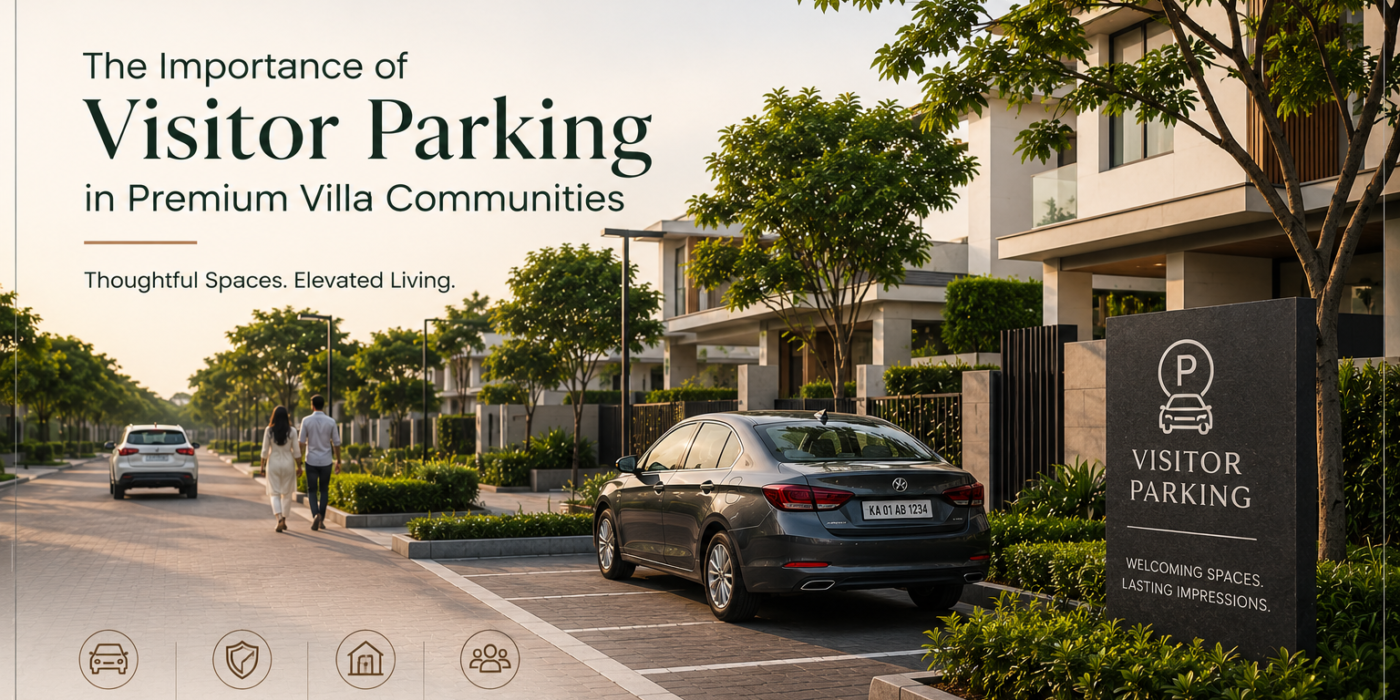
Cars parked at the gate to the villas and a quite road
CategoriesBlog

The Importance of Visitor Parking in Premium Villa Communities

Visitor parking in villa communities rarely makes it onto the headline amenity list in a developer’s brochure, but it consistently makes it onto the list of complaints residents raise after moving in. The reason is straightforward: villas attract more frequent, larger-scale hosting than most other residential formats, and when the community hasn’t been planned with adequate visitor vehicle provision, the friction shows up every time someone hosts a birthday gathering, a family dinner, or a festive celebration.

This gets overlooked during the purchase evaluation because buyers are typically focused on the villa itself during a site visit, the layout, the finishes, the private garden, and the headline amenities like the clubhouse and pool. Parking feels like an afterthought until the first time guests have to circle the internal roads looking for a spot, or until a neighbour knocks to say a visitor’s car is blocking their driveway. By then, the community is already home, and the problem is one to manage rather than avoid.

In this blog, we will see why villa communities specifically need more visitor parking than buyers often expect, what inadequate provision actually feels like to live with, and what to check during a site visit before the purchase is made.

Why Villa Communities Need More Visitor Parking Than Standard Gated Communities

The relationship between home size and hosting frequency is fairly consistent: larger homes accommodate larger gatherings, and villa residents tend to host more often and in greater numbers than apartment residents in the same community. A 3 or 4 BHK villa with a private garden and a generous living area is the kind of space where families host Sunday lunches, festival celebrations, children’s birthday parties, and overnight guests with regular frequency.

Each of these occasions brings vehicles that need somewhere to park within the community rather than on the street outside the gate. A gathering of twelve people arriving by car can generate six to eight visitor vehicles simultaneously, and this is entirely routine for villa residents who use their homes the way larger homes are meant to be used. When visitor parking provision has been calculated for a smaller, apartment-scale hosting pattern, the shortfall becomes apparent very quickly after the community is occupied.

What Happens When Visitor Parking Is Inadequate

The consequences of insufficient visitor parking don’t stay contained to an inconvenience at the gate. They cascade through the community in ways that affect everyone’s daily experience rather than only the residents directly hosting.

Internal Roads Used as Overflow Parking

When designated visitor parking fills up, vehicles default to whatever available surface exists, and in most gated communities that means internal roads. Once cars begin parking on internal roads regularly, the roads narrow effectively for moving traffic, pedestrians lose clear walking space, and the low-traffic environment that villa community residents specifically chose starts to erode. The problem compounds during festive seasons when multiple households host simultaneously.

Blocked Driveways and Neighbour Disputes

A visitor parking on an internal road often ends up partially or fully blocking a neighbouring villa’s driveway, sometimes unknowingly. This is one of the most consistent sources of neighbour friction in gated communities, since it creates a situation where a resident returning home can’t access their own property because of someone else’s guest’s car. Repeated incidents of this type corrode the neighbourly goodwill that community living depends on.

Disrupted Pedestrian and Play Spaces

Children using internal paths for cycling or play, and residents walking between their villas and community amenities, lose safety margin when vehicles overflow into non-designated spaces. The community’s usability as a pedestrian-friendly environment depends partly on vehicles staying where they’re supposed to, which depends on there being enough designated space to accommodate them.

A Premium Community That Stops Feeling Premium

This is the cumulative effect of all the above. A premium villa community where visitors routinely struggle to park, where internal roads have cars lining their edges on weekends, and where parking disputes have become a standing agenda item in resident association meetings doesn’t feel premium to live in, regardless of how well the clubhouse is appointed or how attractively the landscaping was designed.

How Many Visitor Parking Spots Should a Villa Community Have?

There’s no universally agreed ratio, but a practical benchmark for villa communities is roughly one visitor parking spot for every two to three villas, factoring in that multiple households may host simultaneously, particularly on weekends and during festive periods. Communities that fall significantly below this ratio tend to see parking overflow become a regular issue within the first year of occupation. Dedicated overflow zones for large-event occasions, separate from the standard visitor provision, are an additional sign that the developer has thought about peak demand rather than just average demand.

What Good Visitor Parking Design Actually Looks Like

Visitor parking quantity matters, but design quality determines whether the provision actually works as intended. A few specific indicators separate well-planned visitor parking from slots added as an afterthought:

  • Placement near villa clusters rather than concentrated in one corner of the community, so visitors don’t have a long walk and are less tempted to park closer illegally
  • Clear surface demarcation with properly painted bays and directional signage that first-time visitors can follow without confusion
  • Adequate lighting for evening and night visits, since many social occasions extend into the evening
  • Surface quality that remains usable during monsoon without pooling or becoming muddy, which affects both vehicle access and the community’s visual appearance
  • Separation from pedestrian pathways so that parking activity doesn’t create conflict with walking routes

Why Parking Quality Signals Overall Developer Thoughtfulness

A developer who has planned visitor parking carefully has, almost by definition, thought about what it actually feels like to host someone at a villa in their community rather than just what the community looks like when empty. Visitor parking is unglamorous infrastructure, it doesn’t photograph well and it doesn’t feature in architectural renders, which means developers who invest in it are doing so because they’re thinking about the resident experience rather than the sales presentation.

This logic extends to other practical infrastructure decisions: road widths, drainage planning, lighting coverage, and service access. Geown Properties applies this same lived-experience thinking to their 3 and 4 BHK villa projects, where infrastructure planning is treated as part of what makes premium living genuinely premium rather than just visually impressive. More about their current projects is available at www.geownproperties.com.

What Should I Check About Parking When Visiting a Villa Community?

A site visit reveals considerably more about parking provision than a brochure does. A few specific checks worth making:

  • Count the visitor parking slots and estimate the ratio relative to the total number of villas in the project
  • Visit on a weekend afternoon when residents are more likely to have visitors already present, since this shows actual parking usage patterns rather than an empty weekday picture
  • Walk the internal roads and check whether any vehicles are already parked on road edges or in non-designated spaces, since this during a viewing suggests the designated provision is already insufficient
  • Check lighting coverage over visitor parking areas and whether drainage appears adequate for monsoon conditions
  • Ask the sales or site team directly how visitor parking overflow is managed during festive periods or large events

Conclusion

Visitor parking in villa communities matters far more to daily quality of life than its absence from most developer brochures would suggest. For villa residents who use their homes for the kind of hosting that larger spaces naturally enable, adequate and well-designed visitor parking is the difference between a community that supports that lifestyle and one that quietly works against it every time guests arrive.

The buyers who avoid this particular post-purchase frustration are the ones who check parking provision specifically during their site visit rather than assuming it’s been handled adequately. In a premium villa community, the details that most affect how living there actually feels are often the practical infrastructure ones rather than the headline amenities, and parking sits firmly in that category.

woman-with-phone-resting-lying-hammock-with-mobile-phone-scaled
CategoriesBlog

How Well-Planned Villa Communities Adapt to Future Lifestyle Needs

Buying a villa is one of the biggest decisions you will make. While location, design, and price are important, it is equally important to think about how your home will support your lifestyle in the years ahead.

Your needs today may be very different from your needs ten or twenty years from now. Your family may grow, your work style may change, or you may simply want a home that offers more comfort and convenience as you get older. This is why choosing future-ready villa communities is a smart investment.

A well-planned villa community is designed not only for today’s lifestyle but also for the future. From flexible home designs to modern infrastructure and community amenities, these developments help homeowners enjoy long-term villa living without needing to relocate.

Importance of Adaptable Villa Layouts

1. Flexible Home Designs 

A home should adapt to your changing lifestyle instead of limiting it.

Modern developers now focus on adaptable villa layouts that offer flexibility for different stages of life.

For example, an extra room can become:

  • A home office
  • A children’s bedroom
  • A guest room
  • A hobby space
  • A study area

As your family’s needs change, your villa can easily change with you.

2. Spaces That Support Remote Work

Working from home has become a normal part of life for many professionals.

Future-ready villa communities are designed with this in mind by offering homes with quiet workspaces, better natural lighting, and layouts that make it easier to separate work from personal life.

Having enough space to work comfortably from home adds long-term value to your property.

3. Infrastructure That Meets Future Needs

A good villa community is built with long-term planning.

Developments with wide internal roads, proper drainage systems, reliable water supply, power backup, and efficient waste management continue to serve residents well for many years.

Quality infrastructure reduces maintenance issues and improves the overall living experience.

4. Community Amenities That Stay Relevant

Lifestyle needs continue to evolve. Well-planned villa communities include amenities that people of all ages can enjoy.

These often include:

  • Landscaped parks
  • Walking and jogging tracks
  • Children’s play areas
  • Clubhouses
  • Fitness centres
  • Indoor games
  • Community gathering spaces

These facilities encourage healthy living and create opportunities for families to connect with their neighbours.

5. Better Safety for Every Stage of Life

Safety is an important consideration for every homeowner. Future-ready villa communities often include:

  • Gated entrances
  • CCTV surveillance
  • Security personnel
  • Well-lit streets
  • Visitor management systems

These features provide peace of mind for families, children, and senior citizens.

6. Sustainable Features That Reduce Future Costs

Many modern villa communities are designed with sustainability in mind.

Features such as rainwater harvesting, energy-efficient lighting, water conservation systems, and green landscaping help reduce environmental impact while lowering long-term maintenance costs.

Sustainable communities also contribute to healthier living environments.

7. Homes That Support Long-Term Villa Living

As homeowners grow older, accessibility becomes increasingly important.

Wide pathways, comfortable stair designs, spacious rooms, and practical layouts make villas easier to use for every age group.

These thoughtful design elements allow homeowners to enjoy long-term villa living without worrying about frequent renovations or relocating later in life.

8. Strong Investment Potential

Homes designed for future lifestyles tend to remain attractive in the real estate market.

Buyers today look beyond square footage. They value flexible layouts, quality infrastructure, modern amenities, and sustainable living.

Choosing a villa in a well-planned community increases the chances of better resale value and stronger appreciation over time.

9. A Better Community Experience

A home is more than four walls.

Living in a thoughtfully planned community creates opportunities to build relationships, participate in community events, and enjoy a better quality of life.

Open spaces, recreational facilities, and family-friendly surroundings make everyday living more enjoyable.

Conclusion

The best home is one that continues to meet your needs as life changes. Investing in future-ready villa communities gives you the flexibility, comfort, and convenience needed for every stage of life.  

At Geown Properties, we design villa communities that are built for today’s lifestyle and tomorrow’s needs. Our projects combine quality construction, modern amenities, and well-planned living spaces to help families enjoy lasting comfort and value. If you’re looking for a villa that will grow with you, explore Geown Properties and find a home that’s ready for the future.


stylish-caucasian-woman-trendy-panama-waist-neon-bag-roof-bangkok-with-mobile-phone-scaled
CategoriesBlog

How Outdoor Recreational Spaces Add Value to Villa Living

Investing in your home is often synonymous with upgrading kitchens and bathrooms. However, in recent years, homeowners have begun to realize the invaluable benefits of enhancing their outdoor living spaces. 

With a growing focus on outdoor environments, creating functional, aesthetically pleasing outdoor areas can not only elevate your lifestyle but also significantly increase your property’s market value. 

In this article, we will explore why investing in outdoor recreational spaces in villas can be a wise financial decision.

The Rising Trend of Outdoor Living Spaces

According to recent observations, outdoor areas and villa community amenities are gaining traction among homeowners as essential extensions of their living spaces. As a result, many are prioritizing outdoor renovations, including the construction of decks, patios, and even swimming pools. 

While traditional interior renovations like kitchen and bathroom upgrades continue to lead the list for maximum return on investment, these outdoor enhancements are starting to stand out for their potential benefits.

1. Value Recouped

One of the most compelling reasons to invest in outdoor living spaces is the financial return. An outdoor addition, such as a deck or swimming pool, can recoup approximately 65% to 90% of its installation costs upon sale. This investment, therefore, speaks directly to homeowners looking to boost property value without completely reinventing their spaces.

  • Decks and Patios: Low-maintenance decks and patios are amongst the most sought-after features, offering homeowners a comfortable space for relaxation and entertainment while also enhancing the aesthetic appeal of your property.
  • Landscaping: Thoughtfully designed gardens, flowering plants, or sustainable landscaping can also help increase curb appeal, thereby improving overall property value.

2. Enhancing Lifestyle with Outdoor Spaces

Beyond financial benefits, outdoor living spaces greatly enrich homeowners’ lifestyles. Research highlights the positive correlation between spending time outdoors and improved mental health.

  • Stress Reduction: Nature has been shown to alleviate stress, leading to a better mood and overall mental well-being. By creating inviting outdoor areas, you can curate personal retreats right in your backyard.
  • Social Spaces: Outdoor living areas serve as excellent venues for gatherings, allowing homeowners to host family and friends, fostering social connections in a relaxed environment.

3. Environmental and Cost Benefits

Integrating functional outdoor spaces into your property can lead to reductions in maintenance costs and environmental impact.

  • Water Conservation: Implementing features like low-maintenance patios reduces the need for extensive grass lawns, which in turn helps conserve water and lower utility costs.
  • Sustainable Practices: Utilizing environmentally friendly materials in the construction of outdoor spaces contributes to sustainable living by minimizing waste and environmental footprint.

Key Considerations for Outdoor Renovation

When considering an outdoor renovation, keep these factors in mind to ensure your investment is worthwhile:

  1. Design & Functionality: Think about how you intend to use your outdoor space, whether for entertainment, relaxation, or gardening and design accordingly.
  2. Materials: Choose durable, low-maintenance materials that stand up to local weather conditions.
  3. Consult Professionals: Working with professional designers or contractors can yield innovative ideas and ensure quality construction.
  4. Zoning Regulations: Always check local zoning laws, which may impact your renovation plans.

Several studies indicate that well-designed outdoor spaces can significantly increase property value. Features like:

  • Patios: According to the National Association of Realtors, well-maintained patios can add as much as 12% to your home’s value.

  • Pools: Homes with pools can see a return on investment of around 7% to 10%, depending on location and demand.

  • Landscaping and Hardscaping: The key to raising your home’s value often lies in the first impression, and attractive landscaping certainly contributes.

How to Finance Your Outdoor Investment

Investing in outdoor enhancements doesn’t necessarily need to be a financial burden. Many homeowners use creative financing strategies including:

  • Home Equity Loans: These allow homeowners to leverage the equity built in their homes to fund such improvements.
  • Refinancing: Refinancing to pull out cash can provide the means to invest in your outdoor space.
  • Home Equity Lines of Credit (HELOC): This is another option allowing access to funds while keeping repayment flexible.

Conclusion

Investing in outdoor recreational spaces in villas is more than just enhancing aesthetics. It’s a strategic decision that can amplify your home’s value, improve your quality of life, and contribute to environmental sustainability. Whether installing an elegant deck or a serene patio, the benefits of outdoor living spaces are undeniable. As the trend continues to grow, consider your outdoor areas valuable extensions of your home rather than mere afterthoughts.

If you are looking for the best villas in Bangalore, contact Geown Properties. 

adorable-baby-with-parents-park
CategoriesBlog

The Hidden Benefits of Living in a Community Designed for Families

Buying a home is not just about choosing the right villa. It is also about choosing the right community. The people around you, the amenities available, and the environment your family grows in can have a lasting impact on your quality of life.

Today, many homebuyers are choosing family-oriented villa communities because they offer much more than beautiful homes. They provide a safe, welcoming environment where families can build relationships, children can grow with confidence, and everyday life becomes more enjoyable.

Let’s explore the hidden benefits of community living and why a family-friendly villa lifestyle is becoming the preferred choice for modern families.

Benefits of Community Living

1. A Safe Place for Children to Grow

One of the biggest advantages of living in a family-focused community is safety.

Gated villa communities often feature controlled entry points, security personnel, CCTV surveillance, and well-lit streets. Parents can feel more comfortable knowing their children have secure spaces to play, cycle, and spend time outdoors.

Instead of staying indoors, children can enjoy parks, playgrounds, and open spaces while developing confidence and independence.

2. A Strong Sense of Community

Life feels different when you know your neighbours.

In family-oriented villa communities, people often interact during evening walks, community events, and weekend activities. Over time, neighbours become friends who support one another during both everyday moments and special occasions.

This sense of belonging creates a warm and welcoming environment for every member of the family.

3. Better Lifestyle for Every Age Group

A good community is designed for everyone.

Children enjoy play areas, teenagers have space for sports and outdoor activities, adults benefit from walking paths and fitness facilities, while senior citizens can relax in peaceful green spaces.

This balanced environment allows every family member to enjoy an active and comfortable lifestyle without leaving the community.

4. Encourages an Active Lifestyle

Living close to parks, gardens, jogging tracks, and recreational spaces naturally encourages healthy habits.

Morning walks, cycling with children, outdoor games, and evening strolls become part of daily life. Instead of spending more time indoors, families are motivated to stay physically active together.

Small lifestyle changes like these can contribute to better health over the years.

5. More Opportunities for Children to Socialise

Children learn valuable life skills through everyday interactions.

Living in a family-friendly villa lifestyle gives them opportunities to make friends, work together during games, celebrate festivals, and participate in community events.

These experiences help improve communication skills, teamwork, confidence, and emotional development.

6. Peaceful Living Away from City Stress

Many villa communities are planned in locations that offer easy access to the city while maintaining a quieter environment.

With less traffic, lower noise levels, cleaner surroundings, and more greenery, families can enjoy a peaceful lifestyle without feeling disconnected from schools, workplaces, hospitals, and shopping centres.

This balance between convenience and calm is one of the biggest reasons families choose villa communities.

7. Well-Planned Amenities Add Everyday Comfort

Modern villa communities are designed to make daily life easier.

Depending on the project, residents may enjoy amenities such as:

  • Landscaped parks
  • Children’s play areas
  • Clubhouse
  • Indoor games
  • Fitness centre
  • Walking tracks
  • Community hall
  • Sports courts
  • Green open spaces

Having these facilities within the community saves travel time and encourages families to spend more quality time together.

8. Better Long-Term Property Value

Homes located in well-planned family communities often remain attractive to future buyers.

As demand continues to grow for secure, well-maintained residential developments, villas in quality communities have strong potential for long-term value appreciation.

This makes buying a villa not only a lifestyle decision but also a smart investment for the future.

9. Everyday Life Becomes More Enjoyable

Sometimes, the biggest benefits are the simplest ones.

Watching your children play safely outdoors, greeting familiar neighbours during an evening walk, celebrating festivals together, or relaxing in green surroundings all contribute to a happier daily life.

These experiences create lasting memories and make a house truly feel like home.

Find Your Ideal Family Community with Geown Properties

The right home is more than four walls; it is the community that surrounds it.

At Geown Properties, we create thoughtfully planned villa communities that combine modern living with safety, comfort, and a strong sense of belonging. Our projects are designed to support a family-friendly villa lifestyle with quality construction, well-planned amenities, and peaceful surroundings.

If you are looking for a home where your family can grow, connect, and thrive, explore the family-oriented villa communities by Geown Properties and take the first step toward a better way of living.


people-meeting-discussing-neighbourhood-scaled
CategoriesBlog

What Makes a Villa Neighborhood Feel Safe and Welcoming

Finding the perfect home is about more than just the property itself; the neighborhood plays an equally vital role in your happiness and well-being. Choosing the wrong neighborhood can turn your dream home into a nightmare, impacting your daily life, safety, and even your home’s future resale value. 

In this blog, we will explore essential safe villa neighborhoods factors, ensuring that your home purchase aligns with your lifestyle and personal preferences.

Why Neighborhood Matters

When it comes to buying a home, the neighborhood should be your prime focus. Here’s why evaluating the area around your potential home is crucial:

  • Impact on Daily Life: Your neighborhood influences your daily routines, commute times, and recreational options.
  • Resale Value: Homes in desirable neighborhoods tend to retain their value better than those in less appealing areas.
  • Mental Health and Safety: A secure and inviting environment contributes to your peace of mind and overall happiness.

6 Key Considerations for Neighborhood Selection

To help you navigate this important decision, let’s look at five critical factors to consider family-friendly villa communities. 

1. Safety and Crime Rates

Your safety and sense of security are paramount. Research neighborhood crime rates on websites such as CityProtect, CrimeReports, or even local police department resources.

  • Look beyond overall crime statistics; analyze trends. Are crime rates going up or down?
  • Most issues might be property crimes rather than violent ones, indicating a safer neighborhood.
  • Speak to residents about their experiences and feelings of safety.
  • Assess the neighborhood at different times to gauge nighttime safety and noise levels.

2. Quality of Schools and Education Options

Even if you don’t have children, the quality of local schools can significantly impact home values. Areas with reputable schools tend to attract buyers and sell houses faster.

  • Research Ratings: Utilize platforms like GreatSchools or niche.com to check school performance metrics, including test scores and student-to-teacher ratios.
  • Future Projections: Keep an eye on enrollment trends. Are the schools overcrowded, or are new ones being built that could impact traffic and property taxes?

3. Commute Times and Access to Essentials

Evaluate how long it takes to commute to your workplace and access daily essentials. A beautiful home can lose its charm if you’re stuck in traffic for hours daily.

  • Make test drives at typical travel times to gauge traffic conditions. Consider locations like grocery stores, gyms, and schools when evaluating convenience.
  • Stand outside your potential home to listen for noise from nearby roads, trains, or highways that may disrupt peace.
  • Ensure easy access to hospitals, parks, and essential services for your lifestyle.

4. Future Development and Growth

Understanding a neighborhood’s future can help you make a sound investment. Research the city’s planning documents to identify upcoming projects.

  • Zoning Changes: Investigate zoning maps to see what new developments may be proposed.
  • Balance Growth and Congestion: While new developments can increase property values, they could also bring unwanted noise and congestion.

5. Neighborhood Vibe and Community Fit

Every neighborhood has its unique character. Finding a place that aligns with your personality and lifestyle is key.

  • Explore the Area: Walk or drive around the neighborhood at various times to gauge the activity levels and overall vibe.
  • Engage with the Community: Visit local coffee shops or parks and strike up conversations with residents to understand what they love and wish could be improved.
  • Personal Preferences: Consider whether you prefer a quiet area or a lively community with frequent social gatherings.

6. Infrastructure and Essential Services

A neighborhood may look attractive today, but good infrastructure is what makes it comfortable to live in for years to come. Before buying a villa in Bangalore, check whether the area has reliable roads, drainage, water supply, electricity, and internet connectivity.

Also, consider how close the neighborhood is to essential services such as hospitals, supermarkets, pharmacies, banks, and public transport. Easy access to these facilities makes daily life more convenient and adds long-term value to your property.

A well-developed neighborhood not only improves your quality of life but also increases the chances of better property appreciation in the future.

Conclusion

Choosing the safe villa neighborhoods is just as important as selecting the perfect home. By researching key factors like safety, schools, commute times, future development, and the community vibe, you can make an informed decision that meets your needs and enhances your quality of life.

If you’re looking for world-class amenities in a premium gated villa security neighborhood, check out Geown Properties.