
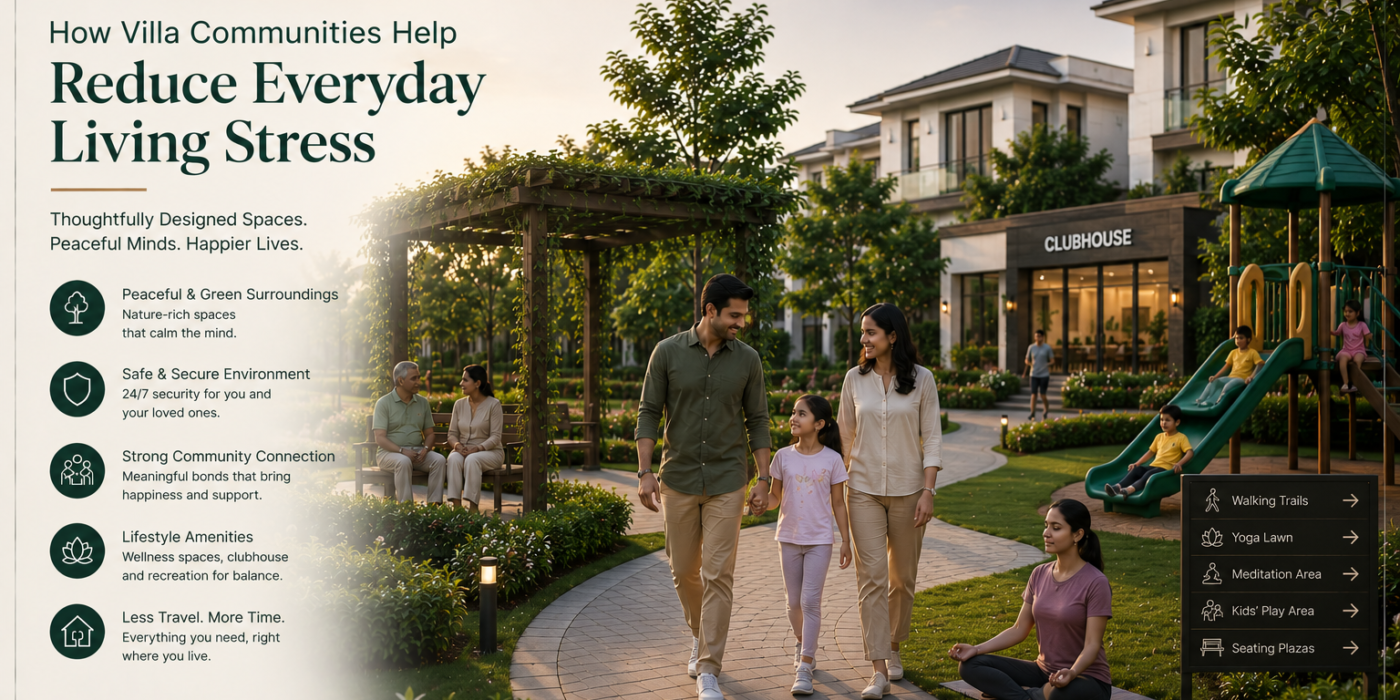
Picture a Tuesday evening. You’ve had the kind of day that accumulates in your shoulders and sits behind your eyes. You turn off the main road onto the quiet lane inside your Villa Communities Reduce Everyday Stress, and something shifts. The noise drops. The pace drops. You park, step out, and walk past a strip of lawn to your front door rather than through a lobby, a lift queue, and a narrow corridor. You open the door to a house that has a garden behind it, and the first thing you hear is your children playing outside rather than the television compensating for the absence of outdoor space. The week hasn’t ended, but the quality of the evening has already changed.
This kind of arrival home is what stress-free villa living actually means in practice, and it isn’t accidental. It’s produced by specific, deliberate features of how Villa Communities Reduce Everyday Stress are designed: the separation from urban traffic density, the presence of personal outdoor space, the quiet that comes from low-occupancy lanes rather than high-rise corridors, and the security that removes the low-level background anxiety that urban living often carries. These features combine to create a residential environment with a genuinely lower baseline stress level than most alternatives, and that baseline shows up every single day rather than only on weekends or holidays.
By the end of this blog, you’ll understand exactly which features of Villa Communities Reduce Everyday Stress living produce that stress reduction and why they work where urban apartments typically can’t.
The Environment You Come Home to Changes How You Feel
Most people attribute their stress to their job, their schedule, or their relationships, and those are all real contributors. What gets underestimated is the chronic, low-level stress that the residential environment itself generates. Noise is one of the most significant: sustained ambient noise, from traffic, from neighbours through shared walls, from lifts and common areas, keeps the nervous system in a mild state of alert that residents adapt to consciously while their bodies continue responding to it.
Visual density does something similar. The experience of constantly navigating crowds, shared spaces, and visually cluttered urban environments keeps attentional systems engaged at a level that drains cognitive resources over time. And the absence of green space has well-documented effects on cortisol levels and psychological restoration, since natural environments genuinely allow the brain to shift out of directed attention into the restorative mode that daily life doesn’t otherwise provide.
The residential environment people return to each evening either compounds the stress accumulated during the day or begins to resolve it. Villa communities are designed in ways that do the latter, and the difference is felt every single day rather than only noticed when it’s absent.
What Peaceful Gated Communities Actually Provide That Dense Urban Living Doesn’t
The features of peaceful gated communities that produce stress reduction aren’t luxuries. They’re specific structural conditions that change the sensory and social environment of daily life in measurable ways.
Low Traffic and Reduced Noise Inside the Community
Internal roads in well-designed villa communities carry only resident traffic moving at low speeds rather than the continuous external vehicle flow that surrounds most urban apartments. The noise reduction this produces isn’t marginal: the difference between a bedroom adjacent to a busy road and one set back in a low-traffic residential lane is a genuinely different sleep and rest quality over time. Children can use outdoor spaces without the constant awareness of passing vehicles that urban streets require, and evenings on a private terrace carry the ambient sound of a residential neighbourhood rather than a city road.
Green Space and Private Outdoor Access
Personal outdoor space, a garden, a courtyard, a private terrace, gives residents something that shared parks and balconies don’t quite replicate: a controllable outdoor environment that’s available without planning, without travel, and without sharing with strangers. The evidence for what this does to daily stress levels is consistent and substantial. Access to personal green space reduces cortisol, supports psychological restoration after cognitively demanding days, and provides the sensory variety that enclosed urban environments lack.
Security That Removes Background Anxiety
Security in a gated community doesn’t only mean physical safety, though that matters too. It means the reduction of a background anxiety that urban residents often carry without fully recognising it: the low-level awareness of who’s in the building, who has access to common areas, whether a stranger in the corridor belongs there. Gated entry, controlled access, and the familiarity of a limited, known resident community remove this layer of ambient vigilance in ways that register as a quality-of-life improvement even when residents struggle to name exactly what changed.
Community Familiarity and Social Connection
Social isolation is one of the most consistent predictors of poor mental health and elevated stress, and high-density urban apartment living often produces it paradoxically: many people around you, very few of whom you actually know. Villa communities, with smaller resident populations and shared outdoor spaces that create incidental daily contact, tend to produce genuine neighbourliness over time. Knowing the families around you, having children who play together, being able to call on a neighbour, these small social textures make a genuine difference to daily wellbeing in ways that take time to notice and tend to be acutely felt only after they’re absent.
Is Villa Community Living Actually Less Stressful Than Apartment Living?
Generally yes, for the specific reasons above rather than as a blanket statement about property types. The stress reduction that villa community living produces is environmental and structural: it comes from lower noise, more green space, less density, personal outdoor access, and greater social familiarity. These conditions consistently produce lower background stress than high-density urban apartment environments in the same way that quieter workplaces consistently produce different cognitive states from louder ones. The difference isn’t subtle once you’ve experienced both across a sustained period.
How Quality of Life in Villa Communities Shows Up in Daily Habits
The most tangible evidence of quality of life in villa communities isn’t in any single feature but in the daily habits that the environment enables and that other residential formats typically don’t:
- Morning coffee on a private terrace or in a garden rather than inside an apartment, creating a genuine transition between night and day
- Children who can be outside independently after school without the coordination and supervision that urban play requires
- Evening walks within the community itself, accessible without crossing a road or leaving a safe environment
- Weekend hosting in private outdoor space without the noise management concerns that apartment hosting requires
- The ability to step outside at any hour without the urban awareness that night-time streets require
Each of these habits seems small in isolation. Accumulated across a week, a month, and a year, they represent a meaningfully different quality of daily life rather than the same life in a larger space.
Why Private Outdoor Space Is the Most Underrated Stress-Reduction Feature
Among all the features that contribute to stress-free villa living, private outdoor space consistently gets the most discussion during a property search and the most appreciation once someone has lived with it. The reason is that its value is experiential rather than logical: it’s very difficult to fully understand what daily access to personal outdoor space does for your state of mind until you’ve spent six months with it.
The research on this is well-established. Access to personal green space is associated with lower cortisol, reduced psychological fatigue, improved mood consistency, and better sleep quality. The mechanism is partly sensory, natural light, greenery, and fresh air, and partly the restorative function that environments without social demands allow the brain to access. A private garden requires nothing from you. It doesn’t need to be navigated, shared, or managed socially. It simply exists as a restorative space available whenever the day requires it.
Geown Properties designs the outdoor space in their 3 and 4 BHK villa communities with this daily quality-of-life function in mind, creating private garden and outdoor zones that serve as genuine restorative environments rather than decorative features. More about their current projects is available at www.geownproperties.com.
What Makes Gated Villa Communities More Peaceful Than Regular Residential Areas?
Several specific design and management features work together to produce the peacefulness that distinguishes well-run villa communities from both urban apartments and open residential layouts:
- Controlled entry that limits vehicle and visitor access to residents and their guests rather than allowing general through-traffic
- Internal road layouts designed for low speed and limited volume rather than efficient throughput
- Landscaping and green buffer zones between homes and roads that absorb both visual and acoustic stress
- Resident-only common areas that are used by known community members rather than the general public
- Active management of noise and community standards that simply isn’t possible in open residential areas without shared governance
Conclusion
Stress-free villa living is produced by a combination of environmental features that systematically reduce the background stress level of daily life: lower noise, personal outdoor space, controlled access, community familiarity, and green surroundings that provide the restorative conditions that dense urban environments don’t. These features don’t eliminate life’s demands, but they change the environment in which those demands are managed, and that change is felt every single day.
The home you come back to at the end of a difficult day either compounds what you’ve carried or begins to release it. In a well-designed Villa Communities Reduce Everyday Stress, the design itself does some of that work for you, which is perhaps the most practical definition of quality of life that a residential property can deliver.