
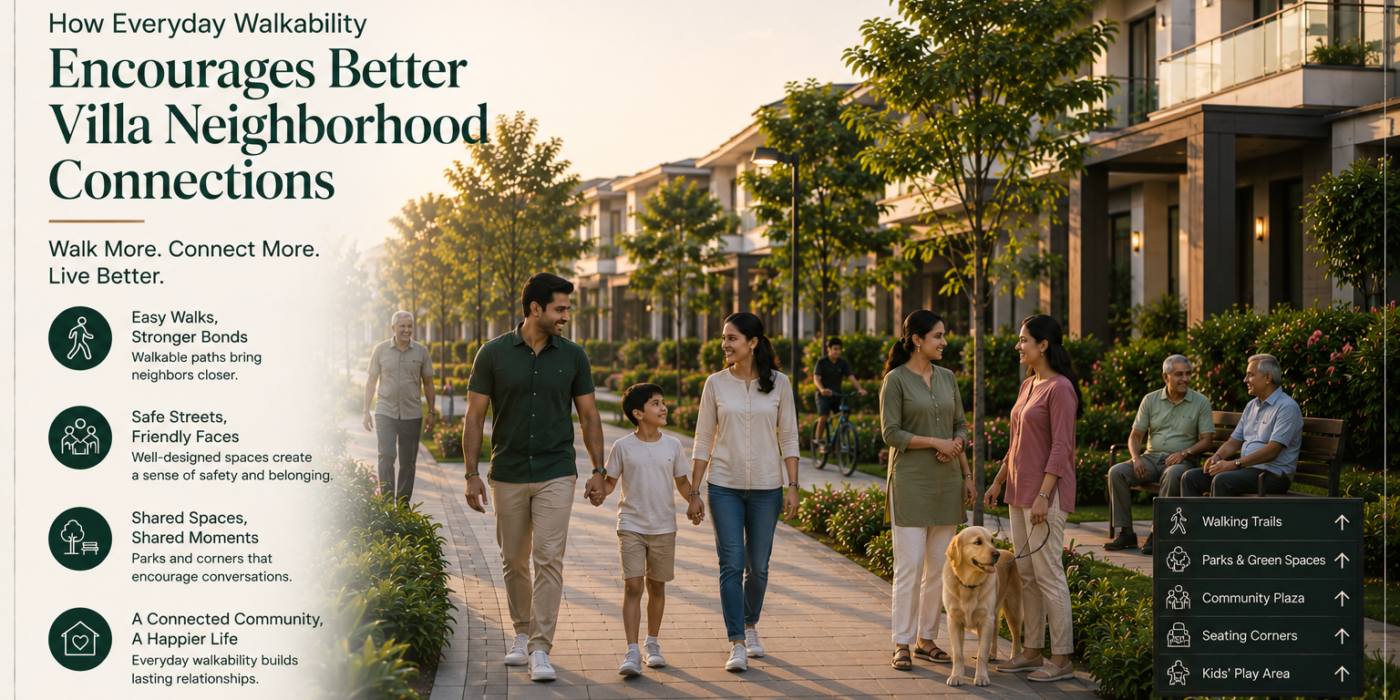
Walkable villa communities build neighbourhood connections through one of the simplest mechanisms available in residential design: when walking is the natural way to move within a community, residents encounter each other regularly, without planning for it, without organising it, and without any formal community activity being involved. Those incidental daily encounters, a brief exchange at the path corner, a wave to a neighbour heading out for an evening walk, children converging on a play area on foot, are what actually build the social familiarity that makes a neighbourhood feel like a community rather than a collection of adjacent private addresses.
This matters more for long-term residential satisfaction than most villa buyers initially weigh during a property search. The ability to walk safely and comfortably within a community affects not just physical activity but the entire texture of daily social life: whether residents know their neighbours, whether children have independent outdoor mobility, and whether the community feels genuinely inhabited rather than merely occupied behind closed doors and parked cars. Communities where every internal journey requires a vehicle produce a fundamentally different social environment from those where walking is easy, comfortable, and naturally rewarding.
In this blog, we’ll look at what walkability actually means in a villa community, how it builds neighbourhood connection, and what design features make it genuinely achievable.
What Walkability Actually Means in a Villa Community
Walkability in a villa community context is more specific than simply having footpaths. A path that’s narrow, unshaded, poorly lit, and leads nowhere residents actually want to go doesn’t produce walking behaviour regardless of whether it exists. Genuine walkability is the combination of infrastructure, comfort, safety, and destination that makes walking the natural choice over driving for journeys within the community.
In practical terms, this means continuous, well-surfaced pedestrian paths that connect villas to amenities, seating areas, gardens, and each other without requiring residents to walk on vehicle roads. It means shade coverage that makes walking comfortable during daylight hours in India’s climate rather than an activity reserved for the coolest parts of the day. It means lighting that makes evening walks feel safe and pleasant. And it means destinations within the community that give residents genuine reasons to be on foot: a pool, a park, a seating cluster near a garden, or simply a well-designed walking circuit that makes the act of walking purposeful rather than merely possible.
How Incidental Contact Builds Real Community
The research on how community social life actually forms is fairly consistent on one point: organised events don’t build genuine neighbourliness, repeated incidental contact does. A community barbecue creates a temporary social occasion. Passing the same neighbours on the community path three or four times a week over months creates genuine familiarity, the kind where you know each other’s names, notice when something seems off, and feel comfortable enough to knock on a door.
This is the social mechanism that walkability delivers. When residents are regularly on foot within their community rather than moving directly from front door to car to road, they share the same outdoor spaces repeatedly and informally. Children who walk to the play area meet the same children regularly. Adults who walk to the amenities in the evening begin recognising the same faces. Over a relatively short time, this repeated low-stakes contact produces the social texture that most residents mean when they describe a community that “has a good atmosphere” but struggle to explain precisely why.
Car-dependent community layouts prevent this almost entirely. When every movement requires a vehicle, residents spend their time in transition, moving between private spaces rather than through shared ones. The community exists as a map rather than as a lived social environment.
Does Walkability Actually Improve Community Social Life?
Yes, and the evidence from urban planning and residential design research points consistently in the same direction: pedestrian-friendly environments produce higher levels of social interaction, greater neighbourly familiarity, and stronger reported sense of community than car-dependent equivalents, even when resident demographics and property values are comparable. The mechanism is incidental contact, not any single intervention.
In Walkable villa communities contexts specifically, walkability also tends to improve the use of shared amenities, since residents who are already comfortable walking within the community use its pools, gardens, and recreational spaces more frequently than those who treat every journey as requiring a vehicle decision. Higher amenity use itself produces more incidental social contact, compounding the original effect.
The Design Features That Make Villa Neighbourhoods Pedestrian-Friendly
Pedestrian-friendly villa neighbourhoods don’t happen by default. They require specific design decisions at the planning stage, and their absence is difficult to retrofit once construction is complete.
Continuous, Well-Surfaced Footpaths
Footpaths need to form a genuine network rather than isolated segments. A path from the villa entrance to the nearest amenity that then disappears, requiring residents to share a vehicle road for the rest of the journey, produces the same walking behaviour as no path at all. Continuous, connected pedestrian infrastructure that covers the whole community is the foundation everything else builds on.
Shade, Lighting, and Comfortable Walking Conditions
An unshaded path in a Bangalore afternoon is a path that won’t be used between roughly nine in the morning and five in the evening for most of the year. Tree canopy or built shade structures over pedestrian paths dramatically extend the daily window in which walking feels comfortable rather than uncomfortable. Evening lighting enables the after-work and post-dinner walks that suit most working residents’ actual schedules, making pedestrian infrastructure useful during the hours residents are actually home.
Internal Destinations Worth Walking To
Paths need reasons to be on them. A walking circuit that loops through well-designed garden areas, passes seating clusters, and connects to the community pool and club creates a journey that feels purposeful. Paths that connect only to other paths, or that lead only from one villa entrance to another without passing through any shared space, don’t generate the walking behaviour that drives social contact.
Safe Separation Between Pedestrian and Vehicle Movement
Pedestrian and vehicle movement need to be physically separated rather than sharing surfaces with painted markings. When residents, particularly children, need to share a road with moving vehicles to get anywhere within the community, walking drops off quickly regardless of how pleasant the destination might be. Physical separation through kerbing, planting, or dedicated pedestrian corridors removes this friction entirely.
Why Community Connectivity Benefits Children Most Visibly
The quality-of-life benefit of walkable community design is perhaps most visible in what it enables for children. Independent outdoor mobility, the ability for a child to walk to a friend’s villa, to the play area, or to a communal garden without requiring adult escort, is one of the most meaningful indicators of family quality of life in a residential community, and it’s something car-dependent layouts consistently fail to provide.
A few specific child-relevant benefits that walkable villa communities deliver:
- Children can form and maintain friendships within the community independently, rather than those friendships depending entirely on adult coordination and transport
- Outdoor play becomes a spontaneous, daily activity rather than a planned, supervised event requiring logistical organisation
- Physical activity increases naturally as part of daily community life rather than requiring dedicated exercise time
- Children develop spatial familiarity and confidence in their own neighbourhood, which has documented benefits for both independence and psychological security
Geown Properties builds pedestrian-first community layouts into their 3 and 4 BHK villa projects, treating walkability as a core community design principle rather than an incidental feature. More about their community design approach is available at www.geownproperties.com.
What Makes a Villa Community Genuinely Walkable?
When evaluating a Walkable villa community before purchase, a few specific indicators are worth checking rather than taking general claims at face value:
- Whether footpaths form a continuous network connecting all parts of the community or exist only in sections near the entrance or main amenities
- Whether shade coverage over paths is natural (mature trees) or structural, and whether it covers a meaningful proportion of the total path length
- Whether the community has internal destinations, gardens, seating areas, recreational spaces, that are positioned along pedestrian routes rather than only accessible by vehicle
- Whether there is genuine physical separation between pedestrian paths and vehicle roads rather than shared surfaces with painted zones
- Whether the path surface quality and lighting coverage suggest year-round, all-hours usability rather than fair-weather, daytime-only walking
Conclusion
Walkable villa communities earn their value primarily through what they make possible socially: the incidental daily encounters that build genuine neighbourhood familiarity over time, the independent outdoor mobility that changes how children experience their own home environment, and the shared outdoor culture that distinguishes a community that feels inhabited from one that merely exists as a residential address. These outcomes are all produced by the same design decisions: continuous pedestrian infrastructure, shade, lighting, destinations, and the physical separation of walkers from vehicles.
The residents who feel most at home in their Walkable villa communities after five years are almost always the ones who walk in them regularly, not because they set out to exercise or socialise, but because the design made walking the easiest, most natural choice for moving through the space they call home.