
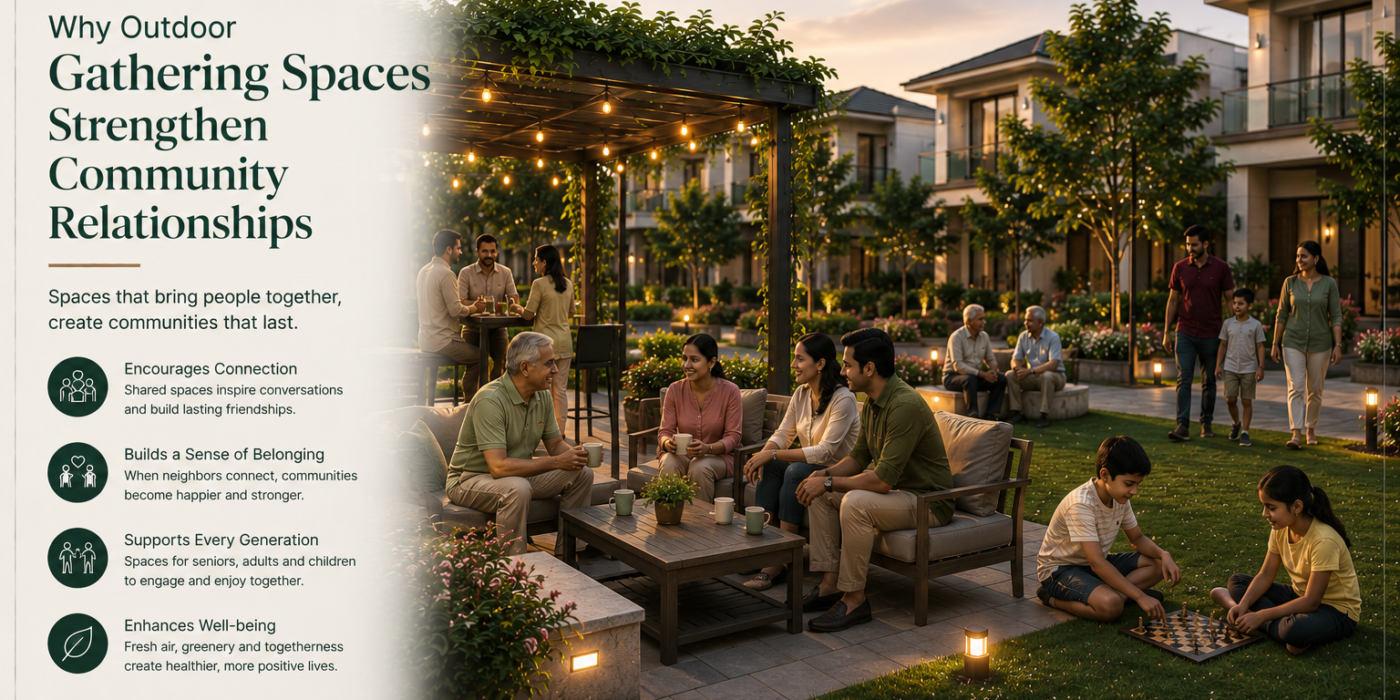
Walk through many villa communities in the evening and the pattern is remarkably consistent: beautifully maintained homes, well-kept lanes, and almost nobody outside. Residents return from work, cars pull into driveways, doors close, and the community settles into a parallel privacy where people live near each other for years without ever really knowing each other. The homes are lovely. The community, in any meaningful social sense, doesn’t quite exist. Outdoor gathering spaces, or rather the absence of them, are usually the reason.
This isn’t a people problem. Residents of villa communities are generally not more introverted or less neighbourly than residents anywhere else. The gap between living near someone and actually knowing them is almost always a design problem: when there’s no comfortable, shared outdoor space that residents move through naturally in their daily routine, the incidental contact that builds genuine familiarity simply doesn’t happen. People stay private not because they choose isolation but because the physical environment offers no easy alternative.
Whether you’re evaluating a villa community for the first time or wondering why your current one hasn’t developed the social life you expected, this blog gives you a clear picture of what outdoor gathering spaces actually do and why their design matters.
The “Before” State: Why Communities Without Shared Gathering Spaces Stay Socially Flat
A villa community without meaningful outdoor gathering spaces produces a specific social dynamic that residents often sense but struggle to name. Neighbours smile and wave in passing. Brief exchanges happen at the community gate or in the parking area. But those exchanges rarely deepen into actual familiarity, partly because there’s nowhere that makes lingering feel natural and partly because encounters happen in transition, between somewhere and somewhere else, rather than in a space where staying for a while is the obvious thing to do.
This social flatness isn’t the result of bad intentions. It’s the result of missing infrastructure. Social relationships require shared territory where people can be present without purpose, where staying is comfortable and leaving isn’t urgent, and where encountering others feels natural rather than engineered. Without a seating area near a garden, a shaded corner near the children’s play zone, or a gathering lawn that makes an evening outside appealing, residents default to their private spaces because those are the only comfortable ones available.
What Outdoor Gathering Spaces Actually Do for Community Social Life
The mechanism through which outdoor gathering spaces build community relationships is straightforward: they create shared neutral territory where residents spend unstructured time, and unstructured time in shared space is what generates the incidental contact that genuine social familiarity grows from.
A resident sitting in a community garden with a cup of tea at six in the evening occupies a space that other residents also move through. An exchange happens. It happens again the following week. Over months, that series of brief, easy, unplanned encounters produces the kind of neighbourly familiarity that organised community events rarely manufacture, because it happens repeatedly, at low social stakes, and without anyone having to make a deliberate social effort. The space does the work that good intentions alone cannot.
How Do Outdoor Spaces Improve Community Social Life?
The evidence from residential design research is consistent: communities with well-used outdoor gathering spaces develop stronger social cultures than those without, measured by resident satisfaction, reported sense of belonging, and the practical behaviours of neighbourliness such as mutual assistance, shared childcare arrangements, and collective response to community issues. The improvement isn’t incidental to the space. It’s produced by it, through the repeated incidental contact that shared outdoor territory makes inevitable.
The social benefit compounds over time. Communities that develop strong social culture through shared outdoor spaces tend to maintain it through resident turnover, because new residents are absorbed into an existing social environment rather than arriving into a vacuum. The space creates continuity that no individual resident’s personal effort could sustain.
The “After” State: How Well-Designed Community Social Spaces Change Daily Life
The after state in a community with genuinely functional outdoor gathering spaces looks fundamentally different from the before state, not because of any single dramatic event but because the texture of daily community life changes in several specific ways.
Spontaneous Weeknight Gatherings That Nobody Planned
When a comfortable outdoor space exists and residents are accustomed to using it, an ordinary Tuesday evening can turn into four families sitting outside together without anyone having initiated anything. One resident comes out for fresh air. A second joins because they see a familiar face. Children gravitate to each other. The gathering happens because the space enables it, not because someone organised it.
Festive Occasions That Become Community Events
Diwali, Holi, and other festive occasions have a different character in communities with shared outdoor gathering spaces. Rather than remaining private family celebrations conducted simultaneously but separately behind different front doors, they spill naturally into shared space, becoming the kind of collective celebration that residents remember and that deepens social bonds considerably faster than ordinary daily contact.
Children’s Outdoor Spaces as Social Catalysts for Parents
One of the most reliably effective social mechanisms in any villa community is a children’s outdoor space that’s comfortably visible from adult seating. Parents who settle in to supervise naturally fall into conversation with other parents in the same position. These conversations happen regularly, at the same time each day, over months, and they consistently produce some of the deepest adult friendships that villa communities generate.
The Long-Term Depth of Relationships That Shared Space Builds
The relationships that form through repeated contact in shared outdoor spaces tend to be more durable and more genuinely mutual than those formed through organised social events. The organic, low-stakes nature of incidental contact builds comfort and familiarity gradually, which means the relationships that result are based on genuine ease with each other rather than the polite performance that social events sometimes produce.
What Separates Functional Gathering Spaces From Decorative Ones
Not all outdoor spaces generate social contact, and the difference between a gathering space that gets used and one that doesn’t is almost entirely design rather than scale or cost. A few specific indicators worth checking:
- Comfortable seating that accommodates groups of varying sizes and that uses materials appropriate for outdoor conditions across all weather
- Shade coverage adequate for daytime use in Indian climate conditions, since an unseated, sun-exposed gathering area won’t be used between morning and evening regardless of how well-positioned it is
- Placement along or adjacent to the natural movement paths of the community rather than set apart in a dedicated zone that requires a deliberate detour to reach
- Appropriate lighting for evening use, when most working residents are actually home and available for outdoor time
- A scale that feels comfortable for both small and larger groups rather than sized for crowds that only exist during organised events
Geown Properties designs outdoor gathering spaces in their villa communities with these functional principles in mind rather than only the visual appeal they contribute to marketing material, ensuring that what’s built gets used in ways that actually build the community social life residents are looking for. More about their approach to community design is available at www.geownproperties.com.
What Types of Outdoor Gathering Spaces Work Best in Villa Communities?
Several space types consistently generate the most social contact in villa community contexts:
- Shaded seating clusters near gardens or water features: these produce the longest average stay times and the most relaxed, extended social contact, since the environment itself encourages lingering
- Children’s play areas with adjacent adult seating: the highest-frequency social catalyst in family-oriented villa communities, generating daily contact rather than weekly or occasional interaction
- Open lawns with flexible use: accommodate both planned gatherings and unplanned groups without requiring any specific furniture arrangement or social configuration
- Covered pavilion or gazebo spaces: enable outdoor gathering during rain, extending the seasonal and daily usability of shared outdoor space beyond the narrow window of perfect weather
Conclusion
Outdoor gathering spaces strengthen community relationships by doing something that individual goodwill and community events cannot: creating the shared physical territory where incidental daily contact happens, and incidental daily contact is what genuine neighbourly familiarity is built from. The before state, a community of private parallel lives in beautiful homes, gives way to an after state of actual social life when the design provides residents with spaces that make being outside together the easiest and most natural option.
The communities that feel genuinely alive to their residents after five and ten years are almost always the ones where somebody, at the design stage, thought carefully about where people would actually sit, gather, and linger rather than only where they would live. That decision, made before a single foundation is laid, shapes what daily community life actually feels like for everyone who eventually calls the place home.