
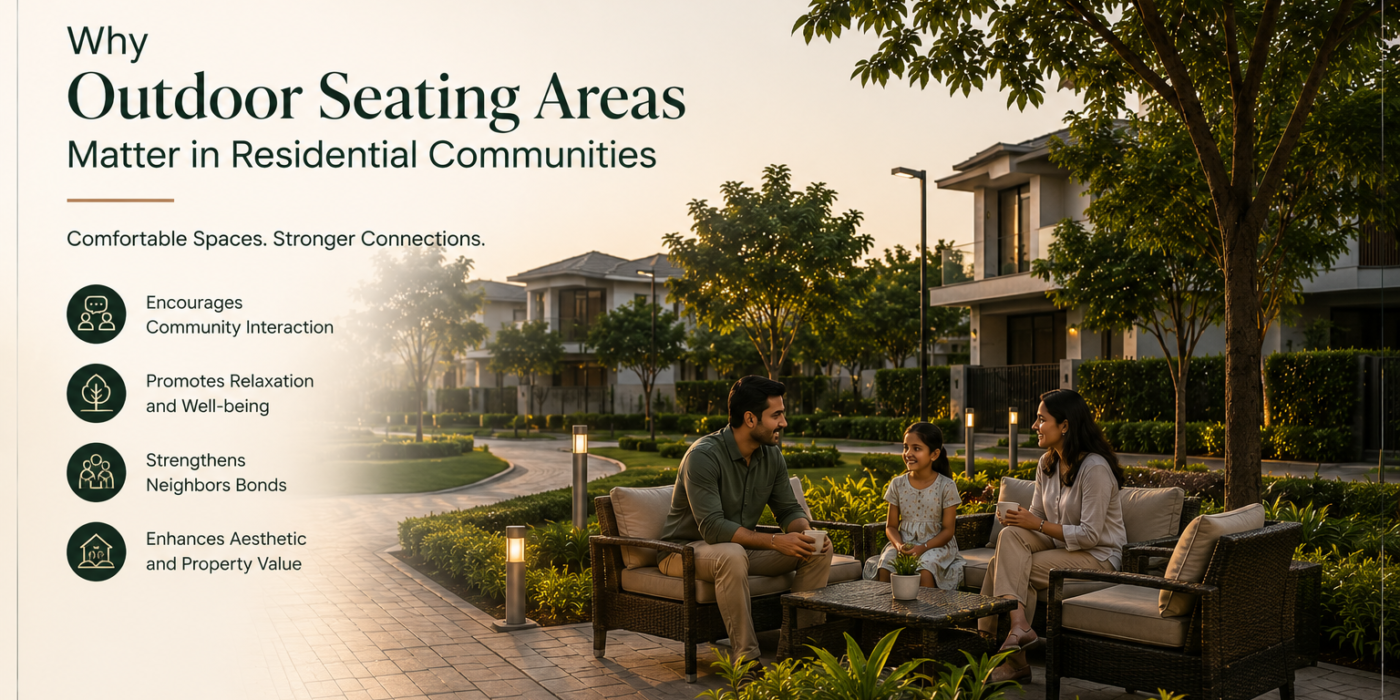
Outdoor seating spaces in communities do something that open green areas alone cannot: they create conditions for staying rather than passing through. A well-positioned bench under a shaded tree, a seating cluster near the pool, or a garden pavilion with comfortable surfaces invites residents to sit, talk, rest, and simply be present in the community rather than moving through it on the way somewhere else. That distinction, between outdoor space for activity and outdoor space for habitation, is what separates a landscape design that residents actually live in from one they only look at.
This matters particularly for villa community buyers, since the outdoor environment of a planned community is part of what justifies the choice over a standalone property. A standalone villa offers a private garden but no shared social landscape. A well-designed villa community offers both, and the shared outdoor seating element is what enables the community interaction that private gardens inherently can’t facilitate. Buying into a community without thoughtful outdoor seating provision means paying for the community premium while missing one of the most tangible benefits it can deliver.
In this blog, we will understand what outdoor seating actually enables in a residential setting, what design choices determine whether it gets used or remains empty, and what to check during a site visit to assess whether a community’s outdoor landscape will genuinely serve daily life.
The Difference Between Outdoor Space and Outdoor Seating
Open green space and designed seating areas serve different purposes, and understanding this distinction helps clarify why both are worth evaluating separately when assessing a community. Open lawns and garden areas support physical activity, informal play, and visual relief from built surfaces. They’re designed for movement and use at a specific time rather than lingering.
Outdoor seating creates a different condition entirely. A seating area says, in physical terms, this is a place worth staying in. It transforms a patch of landscape from a surface to pass through into a destination. Residents sit there with a morning coffee, conversations start because two people happen to arrive at the same time, children play nearby while parents talk, and the community’s social fabric builds through exactly these accumulated informal moments rather than through planned events or organised activities.
What Well-Designed Outdoor Seating Actually Enables
The practical benefits of good outdoor seating in a villa community operate at several different registers simultaneously, each serving different residents and different kinds of community life.
Spontaneous Neighbour Interaction
The most consistent social research finding about community design is that spontaneous, unplanned interaction is what builds genuine neighbourliness rather than organised community events. Outdoor seating creates the physical conditions for this spontaneity: two residents arrive at a seating cluster at the same time, and a conversation happens that wouldn’t otherwise. Repeated across weeks and months, these moments build the kind of familiarity and goodwill that makes a community feel like a community rather than a collection of adjacent private properties.
A Space for Personal Rest and Restoration
Not all outdoor seating use is social. A shaded, comfortable outdoor space near greenery serves as a genuine restorative environment for residents who want to sit quietly, read, or simply be outside without being inside. This personal wellbeing function is distinct from the social function but equally valuable, particularly for residents who work from home or whose daily environment is otherwise predominantly indoors.
Cross-Generational Use Within the Community
Well-positioned outdoor seating is one of the few community spaces that genuinely serves all age groups simultaneously. Older residents and grandparents visiting for extended stays find accessible, comfortable outdoor seating particularly valuable. Parents monitor children from seating areas near play zones. Younger residents use casual seating for informal social gathering. A community where multiple generations use the same outdoor spaces builds a different and richer social texture than one where all spaces are age-specific.
A Social Alternative to the Private Garden
A private villa garden is an excellent space for family use but a poor space for community interaction, since its privacy is both its value and its limitation. Shared outdoor seating provides a social register that the private garden can’t: a place where residents can be part of the community without having to invite someone in. This intermediate social zone, neither fully public nor fully private, is where much of the genuine community social life in a well-designed villa project actually happens.
What Makes Outdoor Seating in a Community Actually Usable?
The presence of seating doesn’t guarantee it gets used. A number of specific design factors determine whether outdoor seating becomes a genuine community asset or a landscape feature that looks good in renders but sits empty in practice:
- Shade provision adequate for the local climate, since unseated seating areas in direct afternoon sun become unusable for most of the day in Indian weather
- Material selection that handles monsoon conditions without becoming slippery, waterlogged, or unattractive after the first rainy season
- Proximity to greenery and natural elements rather than surrounded entirely by hard paving, since people consistently prefer to sit near vegetation when given the choice
- Positioning that allows social orientation, where seating faces toward activity rather than toward walls or service areas, giving residents something to watch and engage with
- Evening lighting that makes outdoor seating usable after work hours, when many residents actually have time to use it
How Residential Landscape Design Shapes Seating Area Quality
Residential landscape design decisions made at the planning stage determine seating area quality in ways that are nearly impossible to retrofit after occupation. Drainage around seating areas, for instance, has to be planned before surfaces are laid: inadequate drainage produces waterlogging that makes seating unusable during and after rain, which in India means for a significant portion of the year.
Shade canopy takes years to establish if it depends on planted trees, which means communities that rely on mature tree coverage for shade need to have planted them years before residents move in. Developers who understand this plant large, fast-establishing species early rather than leaving planting as a landscaping afterthought. The difference between a seating area with genuine dappled shade and one with either direct sun or an artificial canopy structure is significant enough that it shows clearly during a site visit.
Material selection matters across multiple dimensions: durability under heavy use, heat retention on exposed surfaces in summer, slip resistance in monsoon conditions, and visual quality that ages well rather than looking worn within a few years of opening. These decisions reveal how carefully the developer has thought about the experience of actually sitting in these spaces rather than just how they photograph.
Why Seating Distribution Matters as Much as Seating Quantity
A community with all its outdoor seating concentrated in a single central plaza has effectively one outdoor seating area, regardless of how many seats that plaza contains. Residents whose villas are at the community’s edges face a longer walk to reach it, which reduces how spontaneously they use it. Peak times see competition for space while off-peak times see the same area sitting mostly empty.
Distributed seating, positioned in clusters across the community near different villa groupings, amenity areas, and garden zones, produces a fundamentally different pattern of use. Residents near each cluster use it casually and frequently because it’s genuinely convenient. Different areas develop their own social character based on which residents use them regularly. The community feels inhabited across its whole footprint rather than concentrated at one node. Geown Properties applies this distributed seating philosophy to their 3 and 4 BHK villa community design, positioning outdoor seating to serve residents across the full community rather than creating a single showpiece area. More about their approach to community landscape design is available at www.geownproperties.com.
How Much Outdoor Seating Should a Villa Community Have?
There’s no single ratio that applies universally, but a practical way to evaluate adequacy during a site visit is to consider whether seating provision would comfortably accommodate simultaneous use by ten to fifteen percent of the community’s residents at any given time, since peak outdoor seating use rarely exceeds this proportion even in well-used communities. A few specific things worth checking:
- Whether seating clusters exist near each major amenity area, play zone, and garden section rather than only at the clubhouse or entrance
- Whether shade provision is genuine and adequate for afternoon use or whether most seating is in direct sun
- Whether seating surfaces and materials show appropriate weather resistance rather than early wear that suggests poor material specification
- Whether evening lighting covers the seating areas rather than only pathways and roads
- Whether any seating is present near children’s play areas specifically, since this determines whether parents can supervise comfortably and be genuinely present
Conclusion
Outdoor seating spaces in communities matter because they enable the kind of daily outdoor life, restful, social, and spontaneous, that residents move to a villa community to have access to. Without thoughtful seating provision, even a beautifully landscaped community remains a place to look at rather than genuinely live in, which is a significant gap between promise and delivery for families who chose the community lifestyle deliberately.
The communities that get outdoor seating right tend to be the ones where the developer thought about what residents would actually do in these spaces rather than what they would look like in marketing material. That difference in planning orientation shows up very clearly during a site visit, and it’s worth looking for carefully before a purchase decision is made.