
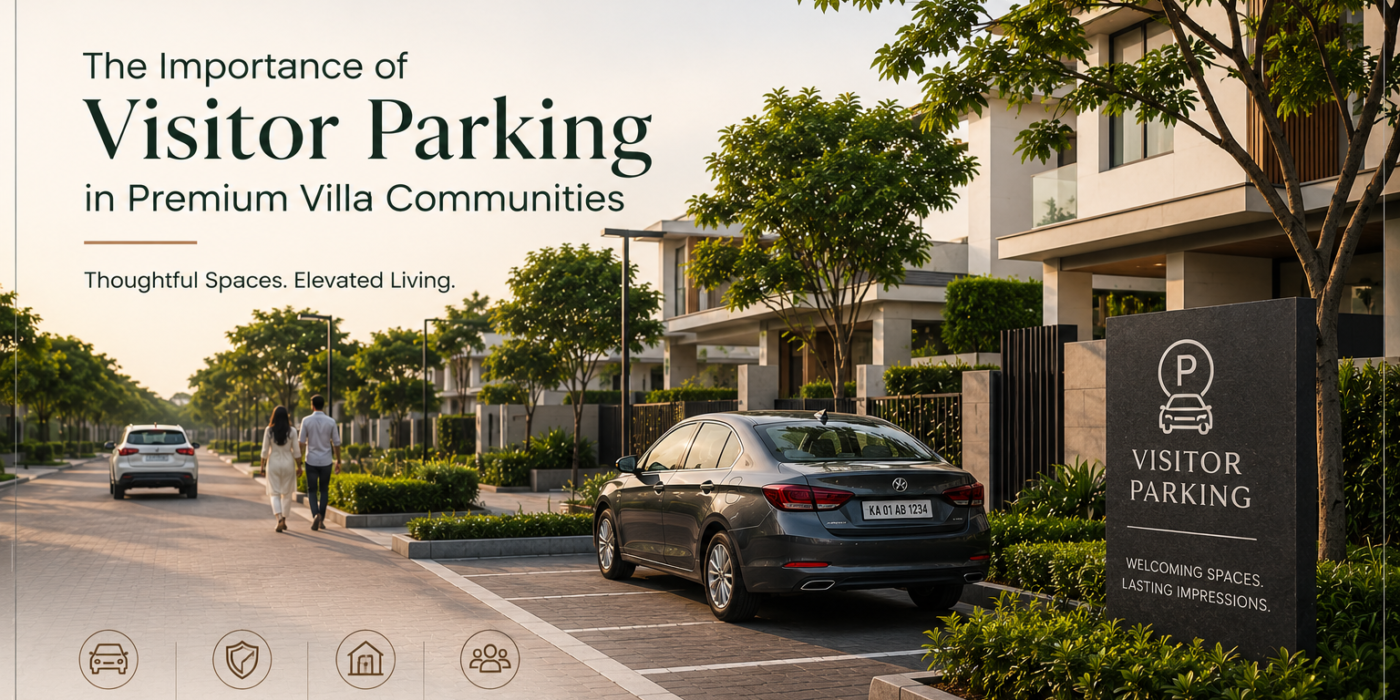
Visitor parking in villa communities rarely makes it onto the headline amenity list in a developer’s brochure, but it consistently makes it onto the list of complaints residents raise after moving in. The reason is straightforward: villas attract more frequent, larger-scale hosting than most other residential formats, and when the community hasn’t been planned with adequate visitor vehicle provision, the friction shows up every time someone hosts a birthday gathering, a family dinner, or a festive celebration.
This gets overlooked during the purchase evaluation because buyers are typically focused on the villa itself during a site visit, the layout, the finishes, the private garden, and the headline amenities like the clubhouse and pool. Parking feels like an afterthought until the first time guests have to circle the internal roads looking for a spot, or until a neighbour knocks to say a visitor’s car is blocking their driveway. By then, the community is already home, and the problem is one to manage rather than avoid.
In this blog, we will see why villa communities specifically need more visitor parking than buyers often expect, what inadequate provision actually feels like to live with, and what to check during a site visit before the purchase is made.
Why Villa Communities Need More Visitor Parking Than Standard Gated Communities
The relationship between home size and hosting frequency is fairly consistent: larger homes accommodate larger gatherings, and villa residents tend to host more often and in greater numbers than apartment residents in the same community. A 3 or 4 BHK villa with a private garden and a generous living area is the kind of space where families host Sunday lunches, festival celebrations, children’s birthday parties, and overnight guests with regular frequency.
Each of these occasions brings vehicles that need somewhere to park within the community rather than on the street outside the gate. A gathering of twelve people arriving by car can generate six to eight visitor vehicles simultaneously, and this is entirely routine for villa residents who use their homes the way larger homes are meant to be used. When visitor parking provision has been calculated for a smaller, apartment-scale hosting pattern, the shortfall becomes apparent very quickly after the community is occupied.
What Happens When Visitor Parking Is Inadequate
The consequences of insufficient visitor parking don’t stay contained to an inconvenience at the gate. They cascade through the community in ways that affect everyone’s daily experience rather than only the residents directly hosting.
Internal Roads Used as Overflow Parking
When designated visitor parking fills up, vehicles default to whatever available surface exists, and in most gated communities that means internal roads. Once cars begin parking on internal roads regularly, the roads narrow effectively for moving traffic, pedestrians lose clear walking space, and the low-traffic environment that villa community residents specifically chose starts to erode. The problem compounds during festive seasons when multiple households host simultaneously.
Blocked Driveways and Neighbour Disputes
A visitor parking on an internal road often ends up partially or fully blocking a neighbouring villa’s driveway, sometimes unknowingly. This is one of the most consistent sources of neighbour friction in gated communities, since it creates a situation where a resident returning home can’t access their own property because of someone else’s guest’s car. Repeated incidents of this type corrode the neighbourly goodwill that community living depends on.
Disrupted Pedestrian and Play Spaces
Children using internal paths for cycling or play, and residents walking between their villas and community amenities, lose safety margin when vehicles overflow into non-designated spaces. The community’s usability as a pedestrian-friendly environment depends partly on vehicles staying where they’re supposed to, which depends on there being enough designated space to accommodate them.
A Premium Community That Stops Feeling Premium
This is the cumulative effect of all the above. A premium villa community where visitors routinely struggle to park, where internal roads have cars lining their edges on weekends, and where parking disputes have become a standing agenda item in resident association meetings doesn’t feel premium to live in, regardless of how well the clubhouse is appointed or how attractively the landscaping was designed.
How Many Visitor Parking Spots Should a Villa Community Have?
There’s no universally agreed ratio, but a practical benchmark for villa communities is roughly one visitor parking spot for every two to three villas, factoring in that multiple households may host simultaneously, particularly on weekends and during festive periods. Communities that fall significantly below this ratio tend to see parking overflow become a regular issue within the first year of occupation. Dedicated overflow zones for large-event occasions, separate from the standard visitor provision, are an additional sign that the developer has thought about peak demand rather than just average demand.
What Good Visitor Parking Design Actually Looks Like
Visitor parking quantity matters, but design quality determines whether the provision actually works as intended. A few specific indicators separate well-planned visitor parking from slots added as an afterthought:
- Placement near villa clusters rather than concentrated in one corner of the community, so visitors don’t have a long walk and are less tempted to park closer illegally
- Clear surface demarcation with properly painted bays and directional signage that first-time visitors can follow without confusion
- Adequate lighting for evening and night visits, since many social occasions extend into the evening
- Surface quality that remains usable during monsoon without pooling or becoming muddy, which affects both vehicle access and the community’s visual appearance
- Separation from pedestrian pathways so that parking activity doesn’t create conflict with walking routes
Why Parking Quality Signals Overall Developer Thoughtfulness
A developer who has planned visitor parking carefully has, almost by definition, thought about what it actually feels like to host someone at a villa in their community rather than just what the community looks like when empty. Visitor parking is unglamorous infrastructure, it doesn’t photograph well and it doesn’t feature in architectural renders, which means developers who invest in it are doing so because they’re thinking about the resident experience rather than the sales presentation.
This logic extends to other practical infrastructure decisions: road widths, drainage planning, lighting coverage, and service access. Geown Properties applies this same lived-experience thinking to their 3 and 4 BHK villa projects, where infrastructure planning is treated as part of what makes premium living genuinely premium rather than just visually impressive. More about their current projects is available at www.geownproperties.com.
What Should I Check About Parking When Visiting a Villa Community?
A site visit reveals considerably more about parking provision than a brochure does. A few specific checks worth making:
- Count the visitor parking slots and estimate the ratio relative to the total number of villas in the project
- Visit on a weekend afternoon when residents are more likely to have visitors already present, since this shows actual parking usage patterns rather than an empty weekday picture
- Walk the internal roads and check whether any vehicles are already parked on road edges or in non-designated spaces, since this during a viewing suggests the designated provision is already insufficient
- Check lighting coverage over visitor parking areas and whether drainage appears adequate for monsoon conditions
- Ask the sales or site team directly how visitor parking overflow is managed during festive periods or large events
Conclusion
Visitor parking in villa communities matters far more to daily quality of life than its absence from most developer brochures would suggest. For villa residents who use their homes for the kind of hosting that larger spaces naturally enable, adequate and well-designed visitor parking is the difference between a community that supports that lifestyle and one that quietly works against it every time guests arrive.
The buyers who avoid this particular post-purchase frustration are the ones who check parking provision specifically during their site visit rather than assuming it’s been handled adequately. In a premium villa community, the details that most affect how living there actually feels are often the practical infrastructure ones rather than the headline amenities, and parking sits firmly in that category.